How to Use a Japanese Onsen: An Illustrated Step-by-Step Guide for First-Timers
Last checked: October 25, 2026, against a Japan Tourism Agency (MLIT) multilingual sign sample, the Japan Tourism Agency tattoo survey as reported by Travel Voice, prefectural and municipal health guidance, and the Japan National Tourism Organization (JNTO) page for Gero Onsen. Rules differ from one facility to the next, so always follow the signs and the staff. This site is independent and is not affiliated with any hot spring or facility. This post may contain affiliate links; if you book through them, we may earn a small commission at no extra cost to you.
An onsen is a Japanese hot spring bath. Most visitors to Japan want to try one, and most are a little worried about doing it wrong. The good news is that the rules are few and easy to follow once you have seen them. This guide walks through the whole visit in order, with illustrations, then covers the questions that cause the most worry: nudity, tattoos, health and where to go from Nagoya.
Key takeaways
- Wash your whole body at a washing station before you get in the bath. Sit on the stool, and rinse off all the soap.
- Bathe without clothes or swimwear. The small towel stays out of the water; many people fold it on their head.
- Photography is not allowed in the bathing area, and a sample official sign also bans alcohol in the bath.
- Tattoos are the biggest worry for visitors. Each facility decides for itself, so check before you go, or book a private bath.
- Start with short soaks. Avoid bathing after drinking alcohol, and stop if you feel unwell.
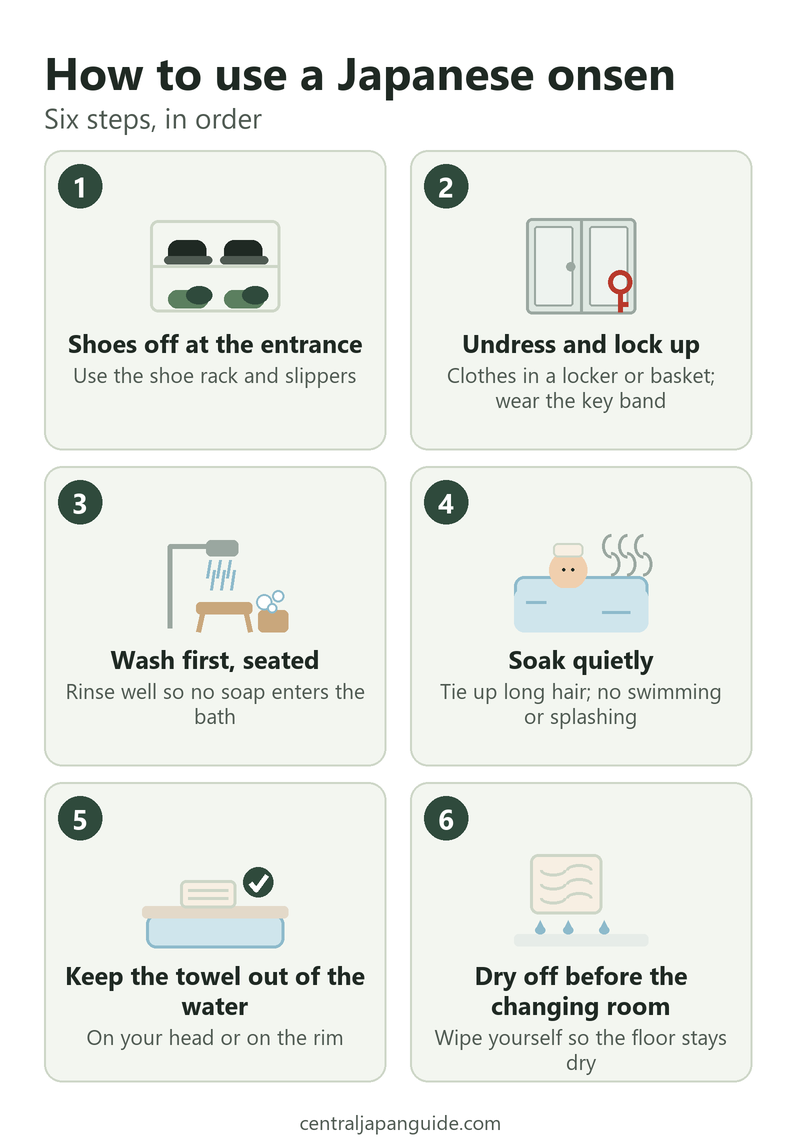
The six steps
1. Shoes off at the entrance
Take off your shoes before you enter the changing or bathing area. Many facilities give you a locker or rack for shoes, and some give you slippers to wear in the building. This is the first rule on the multilingual sign sample published by the Japan Tourism Agency’s sightseeing database, which was prepared for a hot spring in Nagano in fiscal 2018.
2. Undress and lock up your things
The changing room has lockers or baskets. You undress completely: swimwear is not allowed in a Japanese hot spring facility, according to the same sample sign. Many places give you a key on a wristband. Keep it on you, and do not lose it. A large bath towel usually stays in the changing room. You take only the small towel into the bathing area.
3. Wash before you get in
This is the most important rule. Go to the washing area, sit on a stool, and wash your whole body and hair with the soap and shampoo that are provided (or your own). Rinse off all the soap. The sample sign says to scrub thoroughly with the provided facilities before getting into the bath, and that washing stations are usually inside the bathing area. Wash seated rather than standing, so that you do not splash other bathers.
4. Soak quietly
Ease in slowly. The water is often hotter than a home bath. Do not dive, jump, swim or splash: the sample sign notes that the bath is shallow and jumping can disturb other guests, and that the bath is for calm soaking. Most guides also ask you to tie up long hair and keep your head out of the water. These are common habits rather than rules I have found on an official page, so follow any sign posted at the facility.
5. Keep the towel out of the water
Do not dip the small towel in the bath or wring it out over the bath. The sample sign says this is regarded as dirtying the water. Rest the towel on your head or on the edge of the bath instead.
6. Dry off before you go back
Dry yourself well before you return to the changing room, so that you do not leave a wet floor. The sample sign lists this as a rule. Then dress, drink some water and rest for a while.
Inside a typical onsen
The rooms follow the order in which you use them: entrance, changing room, washing area, bath. Some facilities also have an outdoor bath, called a rotenburo.
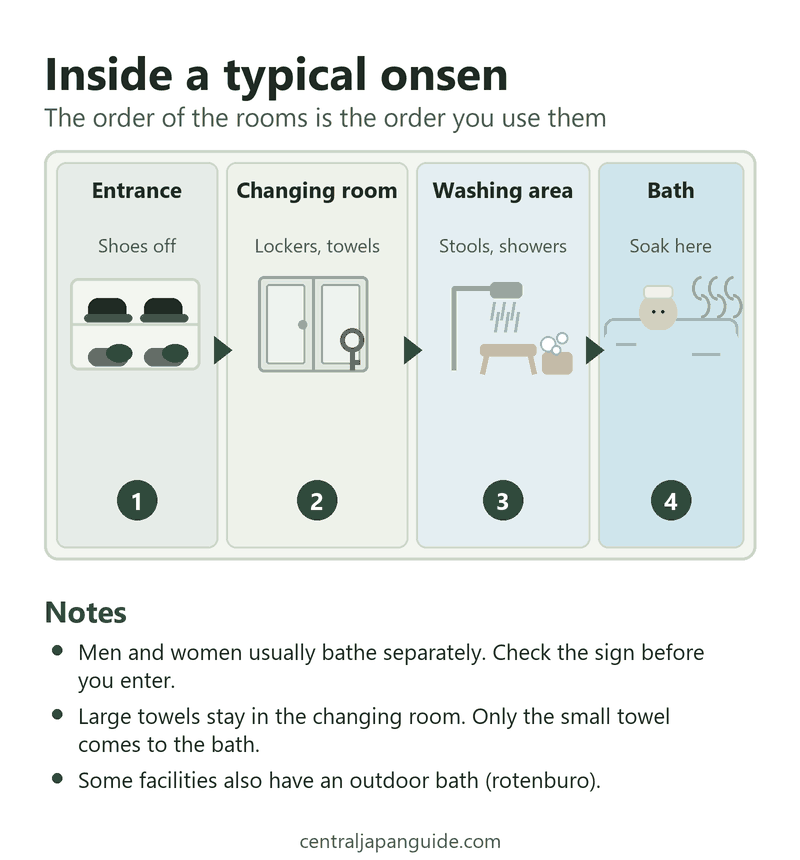
Men and women usually bathe separately. The signs say 男 (otoko) for men and 女 (onna) for women. Some facilities switch the men’s and women’s baths at set times, such as morning and evening, so check the sign each time.
Dos and don’ts at a glance
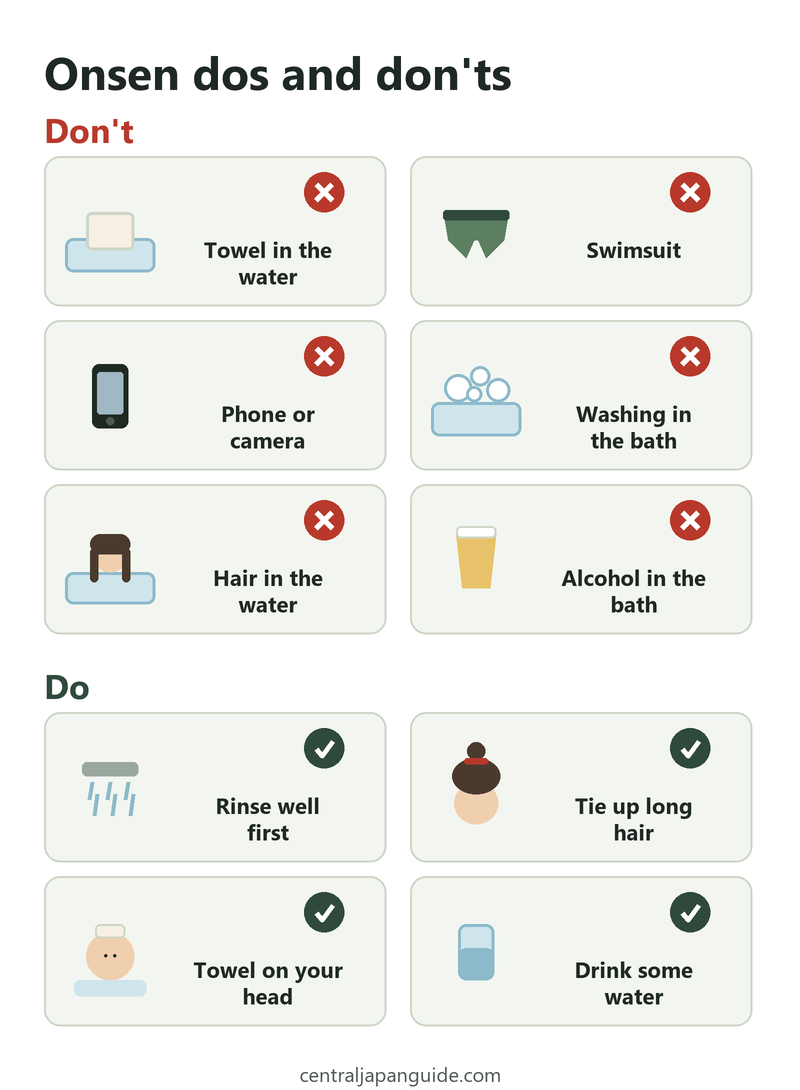
The sample sign from the Japan Tourism Agency’s database lists these as prohibited: swimwear, diving or jumping, dipping the towel in the water, swimming or splashing, photography anywhere in the bathing area, and bringing alcohol into the bath. Smartphones are generally kept out of the bathing area for the same privacy reason. Because you are naked and other people are nearby, do not take any device with you.
What if I have a tattoo?
This is the question that worries visitors most, and there is no single answer.
- Each facility decides. The Japanese government’s position, as reported in parliamentary answers and summarized by Travel Voice and other Japanese outlets, is that the decision belongs to the manager of each facility. The sample sign in the Japan Tourism Agency database is strict: tattoos are barred from the water, although small tattoos that can be covered with a skin-colored waterproof sticker may be accepted.
- The government has asked for flexibility. In 2015, the Japan Tourism Agency surveyed hotels and ryokan that have baths. It sent the survey to 3,768 facilities and received 581 replies. Around 56% refused guests with tattoos, around 31% did not refuse, and around 13% allowed them if the tattoo was covered, for example with a sticker. In March 2016 the agency notified industry groups that refusing a guest only because of a tattoo is not appropriate, and gave examples of how to respond: covering the tattoo with a sticker, not asking for anything special if the tattoo is about the size of a palm, suggesting quiet times, and offering a private bath. These figures date from 2015 and 2016 and come from a secondary news report, so treat them as background, not as today’s rules.
- What to do. Check the facility’s website or ask by phone or email before you go. If the answer is no, consider a private bath (kashikiri-buro) that you book for your own group, or a ryokan room with its own bath. Do not rely on an unofficial “tattoo-friendly” list without confirming with the facility, because policies change.
Health and safety
- Start short. A prefectural health office page that reproduces older national guidance suggests a first soak of about 3 to 10 minutes, depending on the water temperature, and lengthening it gradually if you feel fine.
- Avoid alcohol. The same guidance says to be especially careful about bathing after drinking alcohol, and to avoid bathing immediately before or after a meal.
- Be careful if you have a health condition. A municipal guidance sheet recommends that elderly people, and people with high blood pressure, heart disease or a history of stroke, avoid very hot baths of 42°C or above. If you have a medical condition, ask your doctor before you go.
- Drink water. Guidance from the same municipality recommends drinking a glass of water before bathing, especially first thing in the morning.
- Get out if you feel dizzy. Sit down, cool off and ask the staff for help.
These notes are general health guidance, not medical advice. The national ministry has replaced its older notice with a newer one that I could not read in full, so check the signs at each facility, which often list who should not bathe in that particular water.
Where to try an onsen from Nagoya
Central Nagoya has no famous hot spring district. For a visit built around bathing, one well-known option in Gifu Prefecture is Gero Onsen. JNTO’s page on Gero Onsen gives a travel time of about 1 hour 45 minutes from Nagoya Station on the JR Hida limited express. Timetables and fares change, so check the current times before you go. The same JNTO page, and the town’s own tourism information, are the places to confirm which baths accept day visitors and what they cost. I have not checked each bath’s tattoo policy, so ask the facility first.
Both of the following start from Takayama, not Nagoya, so they suit a trip that includes Takayama. Prices were not shown on the Klook pages without a date, so please check them there.
Gero is on the same JR line as Takayama, so the two combine easily. Gujo Hachiman and Shirakawa-go are reached by other buses, so plan them as separate trips. See our Takayama guide and our Nagoya to Takayama and Shirakawa-go guide.
Frequently asked questions
Do I have to be naked in an onsen? Yes. The sample sign from the Japan Tourism Agency’s database says swimsuits are not permitted. Some “mixed” facilities or private baths have their own rules, so read the sign.
Can I bring my phone or camera? Not into the bathing area. The sample sign says photography in the bathing area is strictly prohibited.
Can I wash in the bath? No. Wash at the washing station first, and rinse off all the soap before you get in.
What do I do with the small towel? Keep it out of the water. Rest it on your head or on the edge of the bath.
Is it allowed with a tattoo? It depends on the facility. Ask in advance, or look for a private bath.
Can I drink alcohol before or in the bath? Do not bring alcohol into the bath. Health guidance advises extra care about bathing after drinking.
Sources
- Japan Tourism Agency multilingual sign “Onsen Manners and Rules”, a sample sign prepared in fiscal 2018 for a facility in Nagano
- Travel Voice report on the Japan Tourism Agency tattoo survey (October 2015, Japanese)
- Aichi Prefecture Institute of Public Health page on bathing precautions (Japanese)
- Morioka City guidance sheet on hot spring use (PDF, Japanese)
- JNTO page on Gero Onsen