Nagoya Station Transfer Guide: JR, Shinkansen, Meitetsu, Kintetsu, Subway and Aonami Line
Last checked: October 31, 2026, against JR Central’s station layout map, Meitetsu’s station guide map and Kintetsu’s English access page. Platform numbers and gates can change during construction, so always follow the signs and departure boards in the station. This site is independent and is not affiliated with any railway. This post may contain affiliate links; if you book through them, we may earn a small commission at no extra cost to you.
Nagoya Station is where almost every trip in this region starts, and it is also where first-time visitors get lost. JR, the Shinkansen, Meitetsu, Kintetsu, two subway lines and the Aonami Line all meet here, but they use different gates, and some are underground. This guide explains which operator goes where, how to walk between them, and which of our day trips starts from which line.
Key takeaways
- Nagoya Station is really several stations side by side: JR and the Shinkansen (above ground), Meitetsu and Kintetsu (underground, next to the JR building), and the subway.
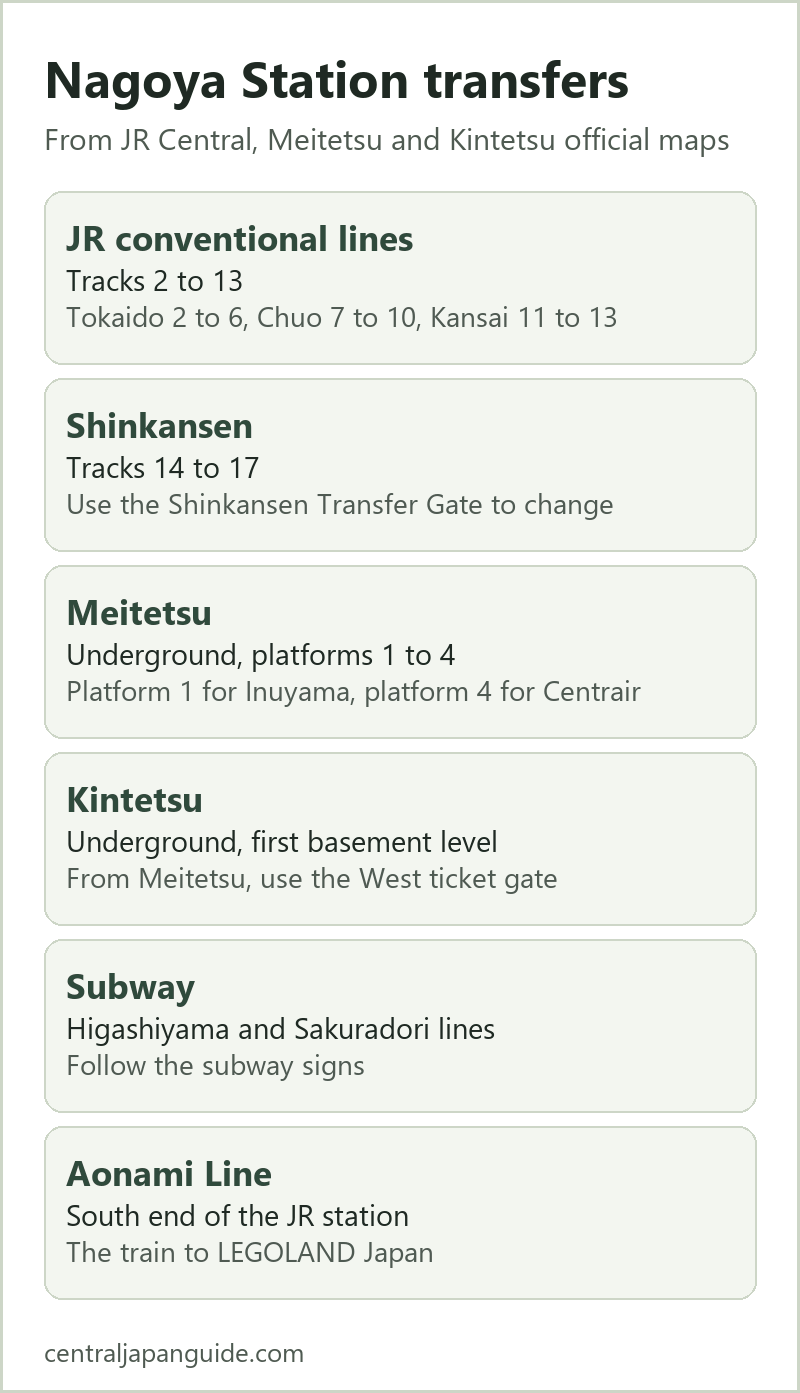
- On JR’s map, the Tokaido Line uses tracks 2 to 6, the Chuo Main Line tracks 7 to 10, and the Kansai Main Line tracks 11 to 13. The Shinkansen uses tracks 14 to 17.
- To change between the Shinkansen and a conventional JR line without leaving the station, use the Shinkansen Transfer Gate.
- Meitetsu Nagoya Station is underground, with platforms 1 to 4 on the second basement level. Its West ticket gate is the way to the JR lines, Shinkansen, Aonami Line and Kintetsu Line.
- Kintetsu Nagoya Station is on the first basement level. Follow the “Kintetsu-Nagoya Sta.” signs, or use the elevator route if you have large bags.
Which line goes where
| Line | Where it starts | Good for |
|---|---|---|
| JR Tokaido Line | Tracks 2 to 6 | Gifu, Toyohashi |
| JR Chuo Main Line | Tracks 7 to 10 | Tajimi, and onward toward Nakatsugawa and Matsumoto |
| JR Kansai Main Line | Tracks 11 to 13 | Kameyama |
| Tokaido and Sanyo Shinkansen | Tracks 14 to 17 | Tokyo, Kyoto, Shin-Osaka |
| Meitetsu | Platforms 1 to 4 (underground) | Inuyama, Toyohashi, Toyota City, Chubu Centrair Airport |
| Kintetsu | Underground, first basement level | Ise, Osaka-Namba |
| Subway | Higashiyama Line and Sakuradori Line | Sakae, Higashiyama Zoo |
| Aonami Line | South side of the JR station | LEGOLAND Japan, Kinjo-futo |
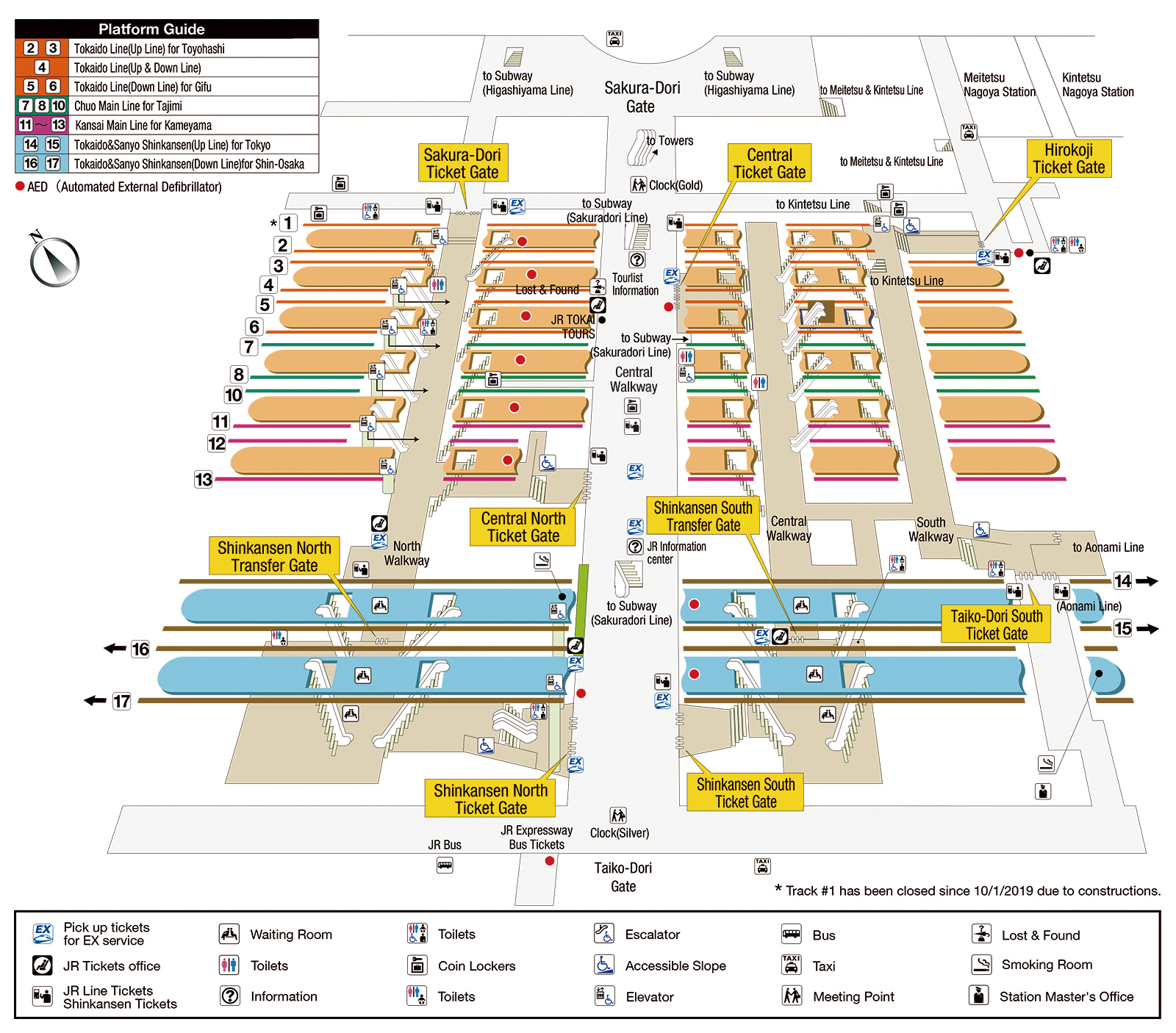
The JR track numbers come from the “Platform Guide” on JR Central’s Nagoya station map, which says Tokaido Line tracks 2 and 3 run toward Toyohashi, track 4 runs in both directions, and tracks 5 and 6 run toward Gifu. Tracks 7 to 10 are on the Chuo Main Line for Tajimi, and tracks 11 to 13 are on the Kansai Main Line for Kameyama. Tracks 14 and 15 are the Shinkansen to Tokyo, and tracks 16 and 17 are the Shinkansen to Shin-Osaka. The map notes that track 1 has been closed since October 2019 because of construction. Limited expresses such as the Hida (to Gero and Takayama) use the JR tracks too, but their platform changes by train. Check the departure board.
Changing between JR lines and the Shinkansen
JR Central’s map shows two Shinkansen Transfer Gates, a north one and a south one. Use them when you move between the Shinkansen and a conventional JR line without leaving the station. The map also shows the Central North Ticket Gate, the Sakura-Dori Ticket Gate, the Hirokoji Ticket Gate and the Taiko-Dori South Ticket Gate for entering and leaving.
The map marks a Tourist Information counter and a JR Tokai Tours office near the central walkway, and coin lockers inside the station. We could not read the exact locker positions on the map, so look for the locker symbols or ask at the information counter.
If you are using a rail pass or buying a combined ticket, ask staff at the Shinkansen Transfer Gate if the gate does not open. This is a practical tip, not an official instruction.
Changing to Meitetsu
Meitetsu Nagoya Station is underground, next to the JR building. Meitetsu’s own guide map shows ticket gates on the first basement level (B1F) and platforms on the second basement level (B2F).
- Gates. The map shows a West, South, North and East ticket gate, plus a Central gate that is exit-only and a Central gate that is entrance-only. The West gate connects to the JR Line, Shinkansen, Aonami Line and Kintetsu Line. The South gate leads to the Meitetsu Bus Center and the JR Line. The North gate leads to the JR Line and the subway.
- Platform 1. For Gifu, Tsushima and Inuyama.
- Platforms 2 and 3. The limited express platforms.
- Platform 4. For Higashiokazaki, Toyohashi, Hekinan, Toyota-shi, Nishio, Central Japan International Airport (Centrair), Kowa and Utsumi.
- Limited express surcharge. Meitetsu says a First Class Car ticket of 450 yen, the same price at any age, is needed in addition to the regular fare for the μSKY Limited Express and for First Class cars on Rapid Limited Express and Limited Express trains. An ordinary car needs only the basic fare.
For the airport, see our Centrair Airport to Nagoya guide. Kintetsu’s English access page says the μ-SKY limited express takes about 30 minutes from the airport to Meitetsu Nagoya Station.
For Inuyama, see our Inuyama Castle guide.
Changing to Kintetsu
Kintetsu Nagoya Station is on the basement level (B1F). Kintetsu’s English page gives these directions from Meitetsu Nagoya Station.
1. Leave Meitetsu Nagoya Station through the West ticket gate. Kintetsu calls it smaller, and says it is the easiest way to the Kintetsu Line. 2. Go down the stairs marked “Kintetsu-Nagoya Sta.” 3. If you have large baggage, take the escalator up to ground level instead and turn left toward the JR Station Building. Enter, turn right and walk past the coin lockers. Turn right at the signs and take the elevator down to B1F. 4. Buy a limited express ticket at the Limited Express Ticket Office if you are taking one. 5. Enter through the Kintetsu ticket gates.
Kintetsu limited express trains need a separate limited express ticket in addition to the basic fare. For a day trip to Ise, see our Ise Jingu guide.
The subway
The Higashiyama Line and the Sakuradori Line both stop at Nagoya Station. JR’s map shows the Higashiyama Line on the Sakura-Dori Gate side, and the Sakuradori Line from the central walkway. We could not confirm the exact route, so follow the subway signs. Meitetsu’s map also shows a connection to the subway from its North ticket gate.
The Higashiyama Line goes to Sakae and to the Higashiyama Zoo area. For fares, day passes and contactless payment, see our Nagoya transport guide.
The Aonami Line
The Aonami Line is the train to LEGOLAND Japan. JR’s map shows the way to the Aonami Line from the south end of the JR station, near the Taiko-Dori South Ticket Gate. Meitetsu’s map also lists the Aonami Line as reachable from the West ticket gate. See our LEGOLAND Japan access guide.
Where our day trips start
- Gero Onsen and Takayama. JR limited express Hida. See our Gero Onsen guide and Takayama and Shirakawa-go guide.
- Magome and Tsumago. JR. See our Nakasendo guide.
- Matsumoto. JR. See our Matsumoto Castle guide.
- Inuyama. Meitetsu platform 1. See our Inuyama Castle guide.
- Ise. Kintetsu. See our Ise Jingu guide.
- LEGOLAND Japan. Aonami Line. See our LEGOLAND access guide.
- Centrair Airport. Meitetsu platform 4 or the μSKY limited express. See our airport guide.
Practical tips
- Give yourself extra time the first time. The station is large, and the walk between operators is longer than it looks on a map.
- Big bags: use the elevators. For Kintetsu, follow the elevator route above.
- Buy the ticket for your operator. A JR ticket does not work on Meitetsu or Kintetsu, and the reverse is also true.
- If you are lost, ask at the Tourist Information counter or the station staff.
- Check the board before boarding a limited express, because platform numbers change by train.
Frequently asked questions
Are Meitetsu and Kintetsu inside JR Nagoya Station? No. They are separate underground stations next to the JR building, with their own gates and platforms.
How do I get from Meitetsu to Kintetsu? Leave Meitetsu through the West ticket gate and follow the “Kintetsu-Nagoya Sta.” signs down to B1F. Kintetsu also describes an elevator route for large bags.
Which platform is the Shinkansen? Tracks 14 and 15 are for Tokyo, and tracks 16 and 17 are for Shin-Osaka, according to JR Central’s map.
Which line goes to Inuyama? Meitetsu platform 1 is for Gifu, Tsushima and Inuyama, according to Meitetsu’s guide map.
Is there a way to change between the Shinkansen and local JR trains? Yes, through the Shinkansen Transfer Gates, which JR Central’s map shows on the north and south sides.