Magome and Tsumago from Nagoya: Nakasendo Walk, Buses and Day-Trip Plan
Last checked: October 21, 2026, against the official Tsumago and Magome tourism sites, the Kitaena Kotsu and Meitetsu Bus timetables, and the Nagano Prefecture tourism site. Timetables, fares and seasonal services change, so please confirm on the official Tsumago site before you go. This site is independent and is not affiliated with any town, bus company or facility. This post may contain affiliate links; if you book through them, we may earn a small commission at no extra cost to you.
Magome and Tsumago are two preserved post towns on the old Nakasendo road, in the Kiso Valley west of the Japan Alps. A stone-paved trail of about 8 to 9 kilometers links them, and many visitors walk it in about 3 hours. From Nagoya it is a long day trip, but it is easy once you know how the buses and trains connect. This guide covers the routes from Nagoya, the walk itself, the luggage service, and the practical details for both towns.
Key takeaways
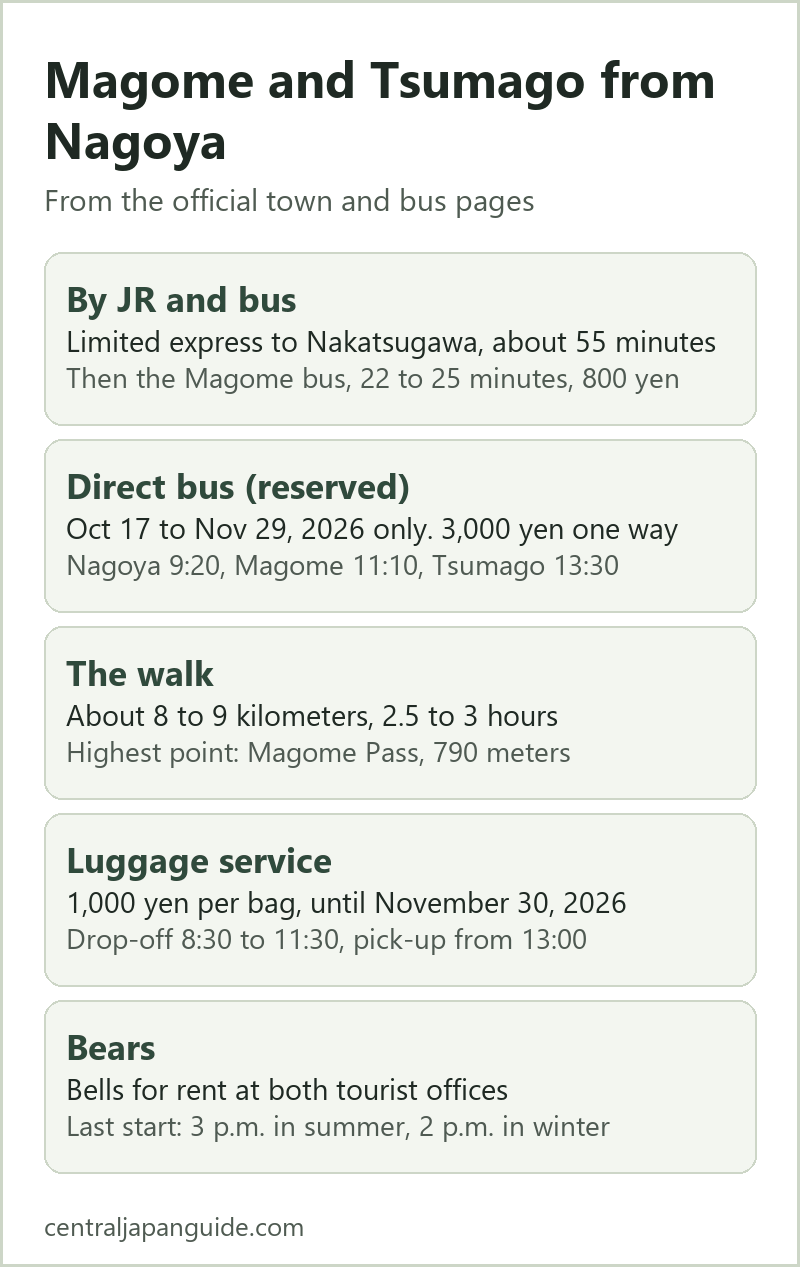
- The walk between Magome and Tsumago is about 8 to 9 kilometers (the sources differ) and takes about 2.5 to 3 hours.
- From Nagoya, take the JR limited express to Nakatsugawa (about 55 minutes), then the Kitaena bus to Magome (about 22 to 25 minutes, 800 yen).
- A reserved direct bus runs from Nagoya to Magome and Tsumago every day from October 17 to November 29, 2026. The fare is 3,000 yen one way.
- A luggage service moves your bags between the two towns for 1,000 yen per bag, until November 30, 2026.
- Bears live in the area, so carry a bell. Both tourist offices rent them. Start early: in summer the last start time is 3 p.m., and in winter it is 2 p.m.
The short version
| The walk | About 8 to 9 kilometers, 2.5 to 3 hours |
| Highest point | Magome Pass, 790 meters |
| Nagoya to Nakatsugawa | JR limited express, about 55 minutes |
| Nakatsugawa to Magome | Kitaena bus, about 22 to 25 minutes, 800 yen |
| Direct bus from Nagoya | October 17 to November 29, 2026 only, 3,000 yen one way, reservation needed |
| Magome to Tsumago by bus | 1,000 yen, 4 buses a day |
| Luggage service | 1,000 yen per bag, March 20 to November 30, 2026 |
Details are from the official sites listed above, on the date above.
How to get there from Nagoya
Option 1: JR train and local bus to Magome
This is the most flexible way, and it works all year.
1. Take the JR Shinano limited express from Nagoya to Nakatsugawa. The Nagano Prefecture tourism site gives about 55 minutes from Nagoya to Nakatsugawa. 2. Leave Nakatsugawa Station, turn left, and find the bus stops in front of Nigiwai Plaza. The Magome bus leaves from stop 3, according to Kitaena Kotsu. 3. Ride the Magome line to Magome. It takes about 22 to 25 minutes, and the fare is 800 yen for adults.
The Kitaena Kotsu timetable (revised October 1, 2025) lists these buses from Nakatsugawa Station:
- Weekdays: 7:42, 9:10, 9:55, 10:45, 11:15, 12:15, then once an hour at :15 until 17:15, and a last bus at 18:30.
- Weekends and holidays: 8:15, 9:10, 9:55, 10:45, 11:15, 12:15, then once an hour at :15 until 16:15, and a last bus at 17:45.
The last bus from Magome back to Nakatsugawa Station leaves at 18:15, according to the Tsumago timetable dated April 1, 2026. The ordinary JR fare is about 1,340 yen according to an itinerary-search site, plus the limited express charge, so check the current price.
A newer bus line also runs from Nakatsugawa Station to Tsumago and Nagiso Station. The operator’s fare chart shows 1,400 yen, so check the timetable for that line on the Kitaena Kotsu site.
Option 2: The direct bus from Nagoya (autumn only)
Meitetsu Bus and Tono Railway run a reserved direct bus from the Meitetsu Bus Center in Nagoya. In 2026 it runs every day from October 17 to November 29.
- Going out. The bus leaves Nagoya at 9:20 and reaches Magome at 11:10. It leaves Magome at 13:05 and reaches Tsumago at 13:30.
- Coming back. The bus leaves Tsumago at 15:20 and Magome at 15:45, and it arrives in Nagoya at 17:20.
The adult fare is 3,000 yen one way, and there is no round-trip discount. You cannot buy a ticket for only the short ride from Magome to Tsumago. Meitetsu Bus says you can also walk from one town to the other, and you can use the bus for only one direction.
If you want to walk Magome to Tsumago with this bus, you have a little over 4 hours, from 11:10 to 15:20. By our calculation that is enough for a 3-hour walk, but tight if you stop often. The bus is by reservation, and the reservation page is on the Meitetsu Bus site.
Option 3: Start from Tsumago by way of Nagiso
You can also start in Tsumago. Take the Shinano limited express to Nagiso Station, then the Nanmoku town bus to the Tsumago stop. The Tsumago tourism site says the taxi takes about 10 minutes, and the walk takes about 40 minutes. The bus takes about 7 minutes, and the fare is 300 yen for adults. The Tsumago timetable says IC cards cannot be used on this bus, so carry coins.
Between the two towns by bus
If you do not want to walk the whole way, a bus connects Magome, Tsumago and Nagiso Station. The fare from Magome to Tsumago is 1,000 yen. From Magome, the Tsumago timetable lists departures at 10:55, 13:25, 15:00 and 17:15, and the ride to Tsumago takes about 26 minutes. From Nagiso Station to Magome, buses leave at 10:10, 12:40, 14:15 and 16:35. A few more trips run only from April 25 to May 6 and from July 25 to August 23.
The Nakasendo walk
The official Magome site says the route (Magome, the pass, Tsumago) is about 9 kilometers and takes about 3 hours. The Nagano Prefecture tourism site says about 8 kilometers and 2 to 3 hours, and Meitetsu Bus says about 8.3 kilometers. The route is the old road, with stone paving, forest, waterfalls and farm hamlets.
Which direction?
The Tsumago site says the climb from Magome to the pass is steep and short, and the climb from Tsumago to the pass is gentle and long. Magome is at about 600 meters and the pass at 790 meters, so walking from Magome means a short climb and then a long, easy descent to Tsumago. That is the usual direction.
Highlights along the way
The two tourism sites list these points:
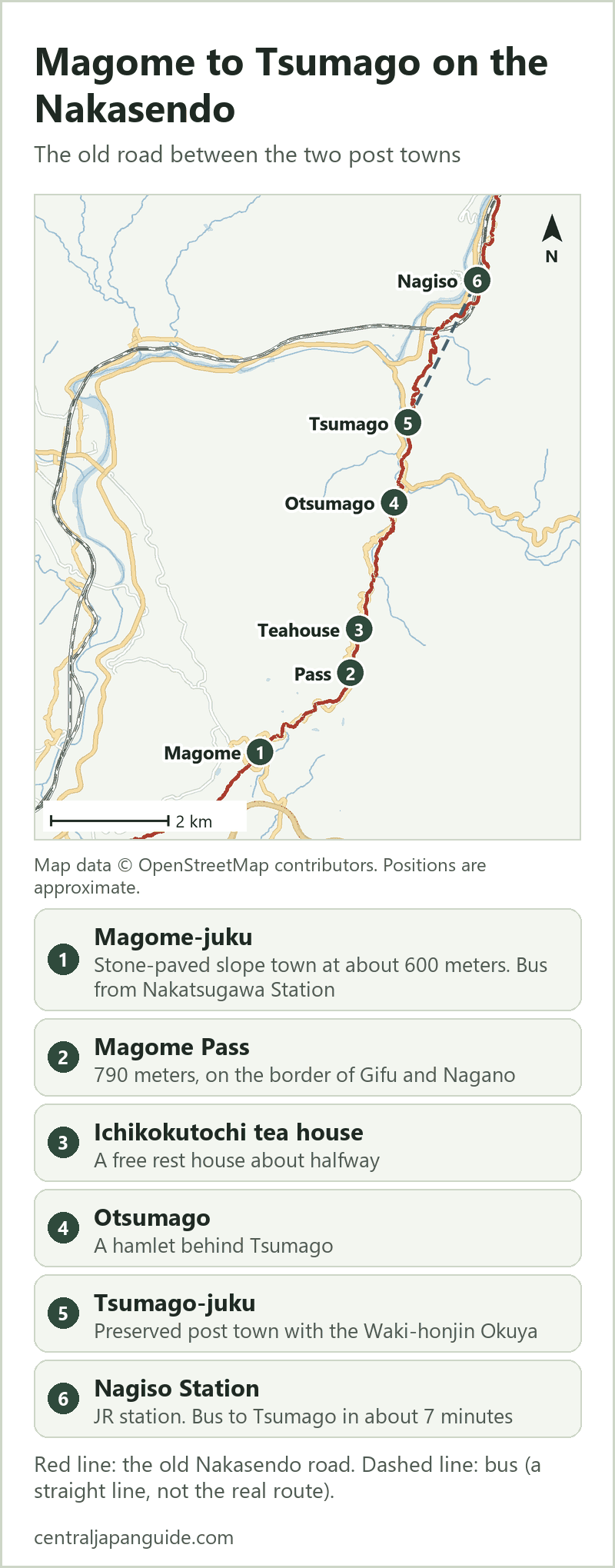
- Magome Pass (790 meters). The border between Gifu and Nagano. A stone monument carries a poem by the poet Masaoka Shiki.
- Ichikokutochi tea house. A teahouse from the middle of the Edo period, about halfway. The Tsumago site calls it a free rest area, and the Nagano site says it is run by a local volunteer.
- Odaki and Medaki waterfalls. Two falls, 10 meters and 12 meters high, linked to the novel about Miyamoto Musashi. A tour operator notes on its Klook page that the path to the waterfalls is under construction until February 2027, so they may be closed on some days.
- Stone paving. Several old sections remain. The Tsumago site warns that the stones are slippery after rain.
- Otsumago. A hamlet behind Tsumago. A prefectural treasure, the Fujiwara family house, stands on the hill.
A shorter option
The Tsumago site suggests an easier course. Take the bus or a car to the pass and walk only the downhill part. It says the gentle slope down to Tsumago takes about 1.5 hours.
What to know before you walk
From the Magome tourism site and the Tsumago tourism site:
- Start early. There are no streetlights, so the last start is at 15:00 in summer and 14:00 in winter.
- Bears. The Tsumago site says bears have been coming down to villages and recommends carrying a bell. You can rent one at the Tsumago or Magome tourist information center. You pay 2,100 yen, and 2,000 yen is returned when you bring it back, so the rental costs 100 yen. A bell is also sold for 2,000 yen.
- Water and food. Few places on the trail sell drinks or food, so bring them. Take your trash with you.
- Rain. There is no place to shelter, so bring rain gear.
- Shoes. Use sneakers or hiking shoes. The Magome site asks you not to wear sandals or heels.
- Strollers and wheelchairs. Not suitable for the trail.
- Winter. The first snow in this area comes around mid-December, and frost can make the trail slippery.
The luggage service
You can walk without your bags. The Tsumago site lists this service between Tsumago, Otsumago and Magome:
| Period | March 20 to November 30, 2026 |
| Drop-off | 8:30 to 11:30 at the Magome tourist information center, Magome-juku BASE, the Tsumago tourist information center, or an inn in Otsumago |
| Pick-up | 13:00 to 17:00 at the same kinds of places |
| Fee | 1,000 yen per bag |
| Outside the hours | A special trip costs 4,500 yen for up to 3 bags, and 1,000 yen for each additional bag |
Phone numbers on the site: Magome information center 0573-69-2336, Magome-juku BASE 0573-64-2750, and Tsumago information center 0264-57-3123 (8:30 to 17:00).
Tsumago
The Tsumago town center is a preserved district. From 10:00 to 16:00 the main street is closed to cars, so you can walk freely.
- Waki-honjin Okuya and the History Museum. One ticket covers both: 800 yen for adults and 400 yen for elementary and junior high school children (changed on April 1, 2026). Open 9:00 to 17:00 (last entry 16:45). Closed on the second and fourth Thursdays of each month, and from December 29 to January 3. The Tsumago Honjin is free.
- Tourist information center. Open 8:30 to 17:00, with maps, bells and the luggage counter.
Magome
Magome sits on a slope, and its main street is a stone-paved road. The town’s own site is the Magome tourism association. The street is closed to cars from 10:00 to 16:00 every day, and most of the parking lots are free.
- Magome Waki-honjin Museum. 300 yen for adults. Open 9:00 to 17:00, with irregular closing days.
- Toson Memorial Hall. About the writer Shimazaki Toson, who was born in Magome. Open 9:00 to 17:00 (to 16:00 from December to March), and closed on Wednesdays from December to February.
- Magome-juku BASE. A visitor center that also handles luggage.
Two sample plans
By JR and local bus (all year).
1. Take a Shinano limited express that reaches Nakatsugawa in time for the 9:10 bus. On a weekday it arrives in Magome about 25 minutes later. 2. Look around Magome, drop your bags at the information center if you need to, and start walking by about 10:30. 3. Reach Tsumago in the early afternoon, visit the Waki-honjin, and take a bus to Nagiso Station. The last bus on the Tsumago timetable leaves Tsumago at 17:41. 4. Take the JR train back to Nagoya.
By the direct bus (October 17 to November 29, 2026). Leave Nagoya at 9:20 and arrive in Magome at 11:10. Walk to Tsumago, and take the 15:20 bus back to Nagoya. If you prefer not to walk, stay on the bus to Tsumago and see both towns, or use the 15:45 Magome departure on the way back.
Guided tours from Nagoya
If you do not want to plan the buses, there are guided day trips from Nagoya. Here are five listed as of October 21 and 22, 2026. Compare them with the costs above.
Tips
- Check the season first. The direct bus and the luggage service end in late November, and the town and bus timetables change in winter.
- Carry coins. The Nanmoku town bus does not take IC cards.
- Book the direct bus early. It is by reservation only, and the Meitetsu Bus page says you can reserve the whole period.
- Add a second stop. For other trips from Nagoya, see our Takayama and Shirakawa-go guide and our guide to getting around Nagoya.
Map
Open these places in Google Maps:
Frequently asked questions
How long is the walk between Magome and Tsumago? About 8 to 9 kilometers, and 2.5 to 3 hours.
Which direction is easier? Walking from Magome to Tsumago means a short climb and a long descent. It is the usual direction.
Can I walk without my luggage? Yes. You can send your bags ahead. The details are in the luggage section above.
How do I get from Nagoya to Magome? Take the JR limited express to Nakatsugawa, then the Kitaena bus to Magome for 800 yen. From October 17 to November 29, 2026, there is also a reserved direct bus for 3,000 yen one way.
Are there bears? The Tsumago tourism site says bears have been coming down to villages, and recommends carrying a bell. You can rent one at either tourist information center.