Japan Practical Travel Guide: Tax-Free Refunds, Luggage, Data, Payments and Emergency Numbers
Last checked: November 2, 2026, against the official refund-method leaflet for travelers from the Japan Tourism Agency and partner agencies (English), the Japan National Tourism Organization (JNTO) website and secondary sources where noted. Rules, fees and services change, so please confirm before you travel. This site is independent and is not affiliated with any government agency or company. This post may contain affiliate links; if you book through them, we may earn a small commission at no extra cost to you.
This is a short checklist of the practical things first-time visitors ask about before a trip to Japan, with a focus on Nagoya and the Chubu region. The biggest news is that Japan’s tax-free shopping system changed on November 1, 2026. If you shop in Japan, read that section first.
Key takeaways
- Since November 1, 2026, tourists pay the tax-inclusive price at the shop and get the consumption tax refunded after customs confirms the goods at departure. The old system, with tax removed at the register, has ended.
- Do the customs procedure within 90 days of purchase, before you check your luggage and before security, at the Customs Tax Refund Kiosk terminal. Keep your purchases in your carry-on.
- At Chubu Centrair and six other airports you can use Visit Japan Web instead of the kiosk.
- Customs checks each receipt as a whole. If even one item on a receipt is missing, none of the items on it qualify.
- The Japan Visitor Hotline (050-3816-2787) answers in English, Chinese and Korean, 24 hours a day. In an emergency, dial 110 for the police and 119 for fire or an ambulance.
- Bags can be sent ahead by courier, and coin lockers cost about 300 to 600 yen depending on size.
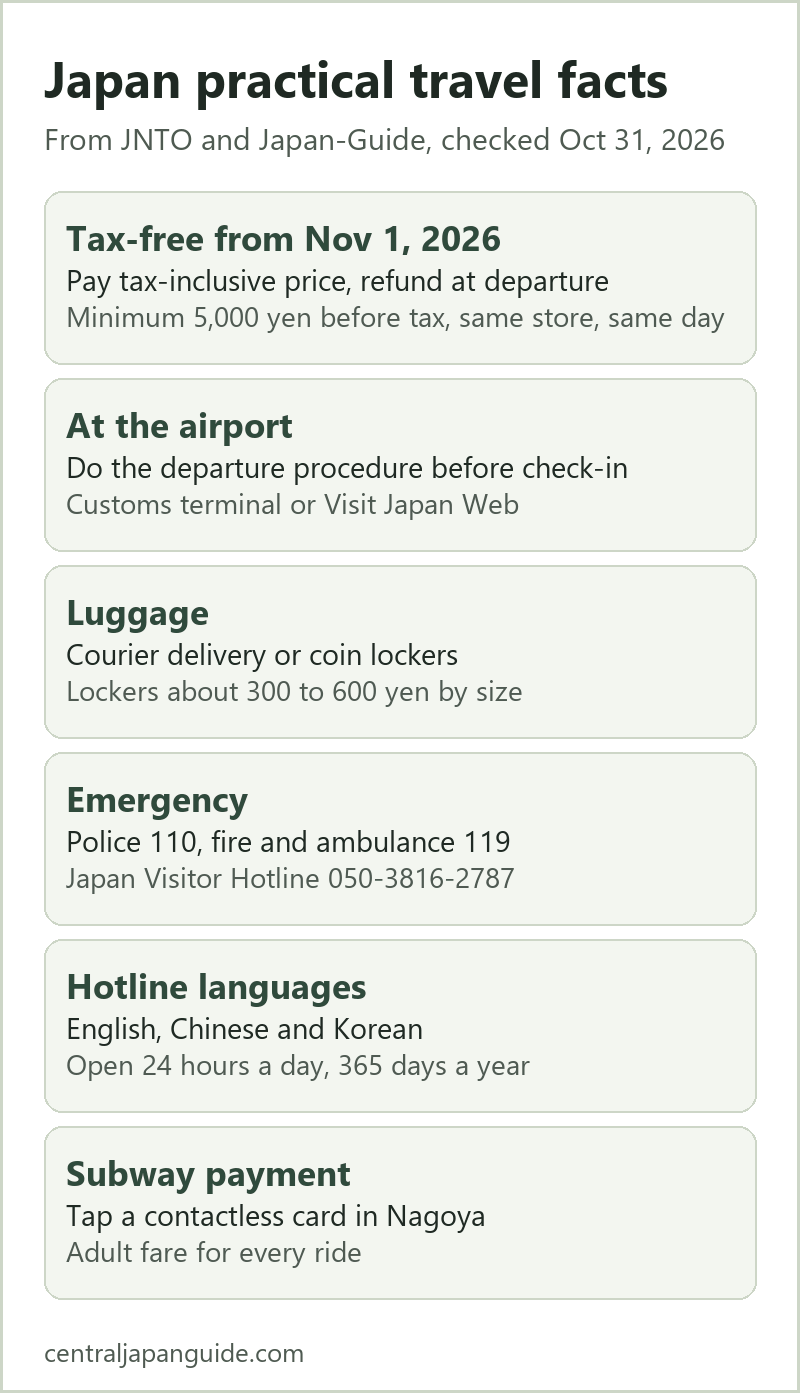
Tax-free shopping changed on November 1, 2026
The Japan Tourism Agency, the Ministry of Economy, Trade and Industry, the National Tax Agency and Japan Customs published a leaflet for travelers titled “The Tax-Free Shopping System Has Changed to a Refund Method.” The steps below follow it. Details the leaflet does not give, such as the minimum purchase, come from the travel news site Japan-Guide and are marked as secondary. JNTO’s own page only says that visitors now pay the consumption tax at the time of purchase and receive a refund after completing the procedures before departure.
The three steps
1. At the shop. You buy at the tax-inclusive price. You register your refund information, such as your card details, and choose how you want the refund. Show your passport at the shop. The leaflet says the shop will explain how to apply for the refund, so ask when you buy. 2. At the airport. Complete the customs inspection before you check your luggage, at the terminal for the Customs Tax Refund Kiosk in the general access area before security. It must be within 90 days of purchase. The kiosk shows a green or red result. Green means the tax-free procedure is complete. Red means customs checks your goods, and goods that fail are not eligible for a refund. 3. After customs. Your refund comes from the shop, and it is processed after the customs inspection.
Visit Japan Web
At some airports you can use Visit Japan Web (VJW) instead of the kiosk terminal. The leaflet lists Narita, Haneda, Kansai, Chubu, New Chitose, Fukuoka and Naha, and says it works within the designated wireless LAN area in the international departure lobby. Chubu is Chubu Centrair, the Nagoya airport. The leaflet adds that registering with VJW before or after you arrive in Japan speeds up immigration and tax-free store procedures.
Rules from the leaflet’s FAQ
- Quantity. What you buy must be limited to quantities you can personally carry out of Japan, and you must be able to show it to customs.
- Consumables. Special packaging is no longer required. Food, drinks, cosmetics and other consumable goods are not eligible for a refund if you use or consume them in Japan.
- One receipt, one check. Customs inspects each purchase transaction. If you do not have even one item from a single receipt with you, none of the goods on that receipt are eligible, including the others.
- Expensive items. For goods costing 1 million yen or more excluding tax, customs may ask for certificates of authenticity or warranties, so have them ready.
- If you do not take the goods out. The amount of consumption tax that was exempted is collected, and you are subject to a penalty.
- Connecting flights. If you transfer from a domestic flight to an international flight, you must complete all refund procedures at the airport where you leave Japan.
- Purchase date. The Japan Tourism Agency’s site says the new method applies to sales from November 1, 2026. Goods bought earlier follow the old rules.
Details not in the leaflet
Japan-Guide reports these points, which we could not find in the official leaflet, so please ask the shop or check the Japan Tourism Agency and National Tax Agency sites.
- The minimum purchase stays at 5,000 yen before tax at one store in one day.
- General goods and consumables are merged, and the old 500,000 yen per-trip cap on consumables is removed.
- Goods must be bought within 90 days of your departure.
- Get a passport stamp when you enter Japan. If you use the automated immigration gates, ask for a stamp right afterward.
Because the system is new, shops may explain the refund differently. Ask how the refund will be paid before you buy something expensive.
Departure tax
Japan raised its international tourist (departure) tax. Japanese media report that the amount is 3,000 yen from July 1, 2026. This is based on secondary sources and we could not confirm it on an official page. It is normally added to your airline ticket price, so you usually do not pay it at the airport. Check your ticket’s tax breakdown or ask your airline.
Luggage: send it ahead or store it
JNTO’s page on luggage says that Narita, Haneda and Kansai airports offer delivery from the airport to your hotel, and that most major hotels can arrange delivery between hotels. Some convenience stores also accept bags for shipping. Look for counters with the “Hands-Free Travel” logo. The carriers named by JNTO are Yamato Transport and JAL ABC.
- Limits. JNTO lists a size limit of up to 160 linear centimeters, a weight of roughly 25 to 30 kg, and a declared value under 300,000 yen.
- Not accepted. Valuables, fragile items, fresh products, liquids and hazardous materials.
- Fees. JNTO does not list delivery fees. They vary by destination and bag size, so ask the counter or your hotel.
- Coin lockers. JNTO says lockers are found at most stations and tourist facilities and cost 300 to 600 yen depending on size. Some accept IC transit cards. Busy stations fill up fast, so go early.
If you are staying at a smaller inn, ask the property first whether it can accept or send luggage. This is a practical tip, not an official rule. For a night at a ryokan, see our ryokan etiquette guide; sending a big suitcase ahead and carrying only an overnight bag makes train trips much easier.
We could not check the luggage services at Chubu Centrair Airport because the airport’s English page did not load for us. Ask at the airport information desk for the delivery counter.
Mobile data, SIM and Wi-Fi
We could not find an official JNTO page that ranks mobile data options, so this section is general information from commercial travel sites, many of which sell these products.
- eSIM. If your phone supports it, you scan a QR code and get data without visiting a shop. Install it before you leave home.
- Physical SIM. For phones without eSIM support.
- Pocket Wi-Fi. A rented device that several people can share. You pick it up and return it.
- Free Wi-Fi. It is available at many airports, stations and sights, but sources describe it as uneven. Registration can be required, and it may drop out. Do not rely on it as your only connection.
- Offline maps. Download maps for Nagoya and your day-trip areas before you go. Mobile signal can drop in mountain areas.
If you plan to buy an eSIM, compare coverage and validity days, and check that your phone is unlocked.
Paying: cash, cards and the subway
Japan is more cashless than before, but cash still matters at small shops, shrines and rural bus stops.
- Subway. Since September 3, 2026, Nagoya’s subway accepts tap payment with contactless Visa, Mastercard, JCB, American Express, Diners Club, Discover and UnionPay. See our Nagoya transport guide for the rules, including that every ride is charged as an adult fare.
- Keep some cash. Carry a few thousand yen in coins and bills for lockers, small restaurants and temples.
- Know your card’s limits. Some rural facilities accept only cash or only certain card brands. Ask before you order.
Emergencies and help
JNTO lists the following numbers.
| Service | Number |
|---|---|
| Police | 110 |
| Fire and ambulance | 119 |
| Japan Visitor Hotline (JNTO) | 050-3816-2787, or +81-50-3816-2787 from overseas |
| Lost and found (JNTO page) | 0570-550-142 |
JNTO says the Japan Visitor Hotline operates 24 hours a day, 365 days a year, in English, Chinese and Korean, for tourist information and for help with accidents, illness and natural disasters. JNTO also provides a guide for when you feel ill.
If you lose something on a train or in a station, ask the nearest station staff first. They can tell you where the lost property office is.
Pre-trip checklist
- Check that your passport is valid for your whole stay.
- Register your trip on Visit Japan Web if you plan to use it for the departure procedure.
- Install an eSIM or arrange Wi-Fi before you leave.
- Save the hotline number and your hotel’s address in Japanese on your phone.
- Plan which bags to send ahead and which to carry.
- Keep receipts for tax-free purchases and do not open consumables.
More guides for your trip
- Getting around Nagoya
- From Centrair Airport to Nagoya
- 3-day Nagoya itinerary
- How to use a Japanese onsen
- Ryokan etiquette
Frequently asked questions
Is tax-free shopping ending in Japan? No. Japan is changing how it works. From November 1, 2026, you pay the tax-inclusive price and receive a refund after the departure procedure.
Is the minimum purchase still 5,000 yen? Japan-Guide reports 5,000 yen before tax at the same store on the same day. The official leaflet does not state a minimum, so confirm with the shop.
Can I open snacks I bought tax-free? Not if you want the refund. The official leaflet says food, drinks, cosmetics and other consumables are not eligible if you use or consume them in Japan.
Who do I call in an emergency? Dial 110 for the police and 119 for fire or an ambulance. For information and support in English, Chinese or Korean, the JNTO Japan Visitor Hotline is 050-3816-2787.
Can I send my suitcase to the next hotel? In most cases, yes. JNTO says most major hotels can arrange delivery between hotels, but smaller inns may not.
Sources
- Japan Tourism Agency and partners: The Tax-Free Shopping System Has Changed to a Refund Method (leaflet for travelers, PDF)
- Japan Tourism Agency: Tax-free shop site (Japanese)
- JNTO: Changes are coming to tax-free shopping in Japan
- Japan-Guide: Japan’s tax-free shopping rules change from November 2026
- JNTO: Luggage delivery and storage
- JNTO: Japan Visitor Hotline and emergency numbers