Gujo Hachiman from Nagoya: Castle, Water Town, Food Samples and How to Get There
Last checked: October 22, 2026, against the official Gujo Hachiman Tourism Association website (Japanese and English pages) and the Gifu Bus website. Hours, fares and event dates change, so please confirm on the official site before you go. This site is independent and is not affiliated with the town or any facility. This post may contain affiliate links; if you book through them, we may earn a small commission at no extra cost to you.
Gujo Hachiman is a small castle town in the mountains of Gifu, north of Nagoya. Clear rivers run around it, water channels run along its old streets, and a wooden castle stands on the hill above. It is also where the plastic food samples seen outside Japanese restaurants were invented, and you can make your own. Below are the routes from Nagoya, the castle, the old streets, the food sample workshops and the best seasons.
Key takeaways
- A direct highway bus runs from the Meitetsu Bus Center in Nagoya to Gujo Hachiman Jokamachi Plaza, near the town center. The adult fare is 2,400 yen, and seats are reserved.
- Gujo Hachiman Castle is the oldest reconstructed wooden castle in Japan. Adults pay 400 yen.
- The tourism association says 70 percent of the plastic food samples made in Japan come from Gujo Hachiman. Workshops need a reservation.
- The 2026 Momiji (autumn leaves) Festival runs from November 1 to 30. The official English page expects the peak from November 9 to 17.
- The town is best seen on foot. The tourism association suggests about 2 hours for its self-guided walk.
The short version
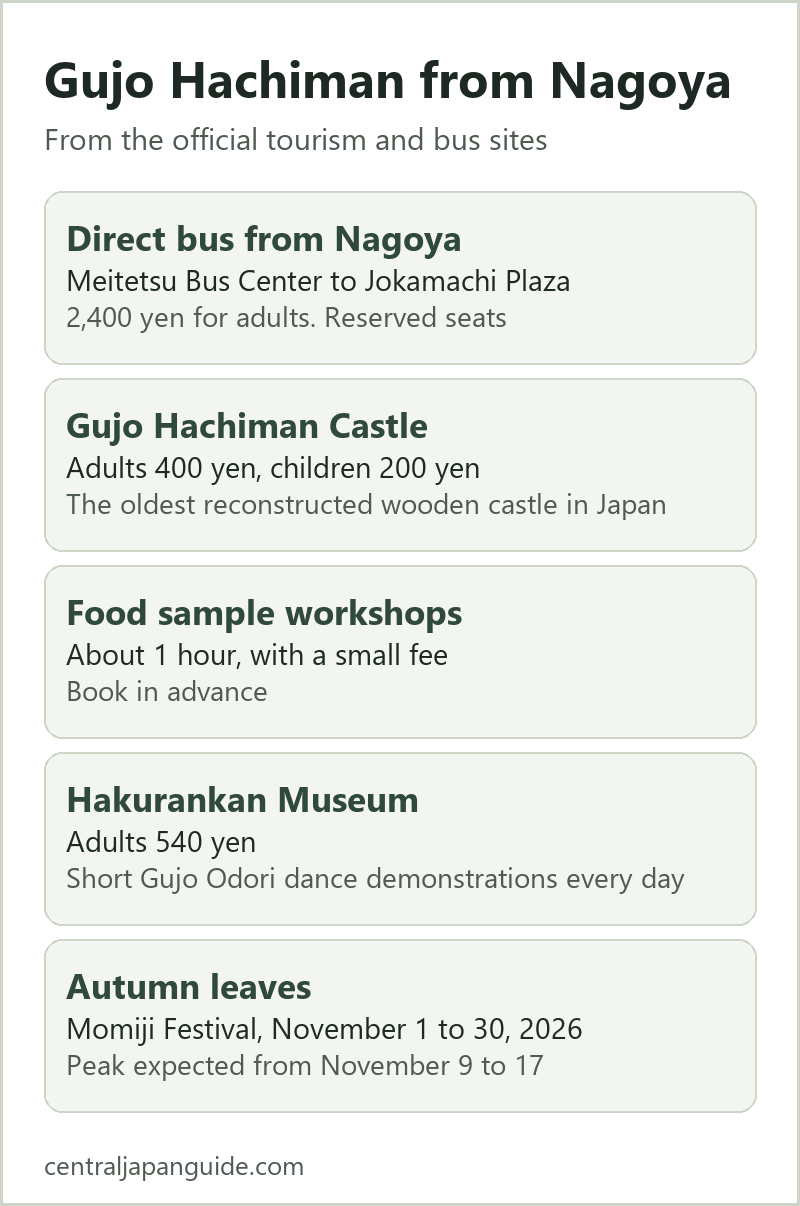
| Bus from Nagoya | Meitetsu Bus Center to Jokamachi Plaza, 2,400 yen for adults, reserved seats |
| Castle admission | Adults 400 yen, children 200 yen |
| Hakurankan Museum | Adults 540 yen, children 320 yen |
| Food sample workshops | About 1 hour, small fee, reservation needed |
| Walking time | About 2 hours for the official self-guided walk |
| Autumn leaves | Momiji Festival, November 1 to 30, 2026 |
All details are from the official tourism association and Gifu Bus websites on the date above.
How to get there from Nagoya
Direct highway bus to the town center
The Gifu Bus “Nagoya Gujo Hirugano Line” leaves from the Meitetsu Bus Center at Nagoya Station. According to the Gifu Bus fare table:
- Fare. 2,400 yen for adults from the Meitetsu Bus Center to Gujo Hachiman Jokamachi Plaza. Children pay half.
- Seats. Reserved seats, with priority for passengers who have booked.
- The stop. The tourism association says Jokamachi Plaza is close to the town center and the best stop for sightseeing.
The Gifu Bus timetable is a PDF on its site, so check the times there. Travel sites give about 1 hour 30 minutes for the ride, but we could not confirm the time on the official page.
By train and bus through Gifu
The tourism association recommends the JR Tokaido Line from Nagoya to JR Gifu Station, then the bus to Gujo Hachiman from bus stop 14 at JR Gifu Station. It says the Meitetsu Bus Center at Meitetsu Gifu Station closed on October 1, 2024, so the buses now leave only from JR Gifu Station.
Stopping on the way to or from Takayama
Highway buses on the Nagoya to Takayama route stop at the Gujo Hachiman highway bus stop, about 2 kilometers from the town center. The tourism association lists a pick-up taxi from that stop to Jokamachi Plaza:
- Fee. 350 yen per person (infants free).
- Reservation. Required before your highway bus leaves Nagoya, Takayama or Osaka. Call 0120-053155 (9:00 to 17:00), or book online through the official site.
So you can stop in Gujo Hachiman on your way to Takayama. See our Takayama old town guide and our guide to the Nagoya to Takayama route.
By the Nagara River Railway
The tourism association also suggests the Nagara River Railway from Mino-Ota Station, a local line it describes as relaxing and scenic.
Gujo Hachiman Castle
The castle stands on Hachiman Mountain above the town. According to the tourism association, the first castle was built in the 1500s and taken down in 1870, and the present wooden keep was built in 1933 as one of the first castle reconstructions in Japan. It is the oldest reconstructed wooden castle in the country. The writer Shiba Ryotaro called it the most beautiful mountain castle in Japan.
- Admission. Adults 400 yen and children 200 yen. The grounds are free.
- Hours. 9:00 to 17:00 from March to May, and 9:00 to 16:30 from November to February. Last entry is 15 minutes before closing.
- Summer hours. The Japanese page gives 8:00 to 18:00 from June to August, and the English page gives 8:00 to 16:00. Several travel sites also give 8:00 to 18:00 for summer, so the English figure may be a typo, but this is not confirmed. The official pages do not list September and October. Check before you go.
- Getting to the top. The parking lot at the top is free but small, and the road has tight curves, so large vehicles and cars for six or more people cannot use it. The tourism association suggests parking near the statue of Yamauchi Kazutoyo and walking up in 15 to 20 minutes.
The castle is surrounded by maple trees, and autumn is a popular season to visit. In 2026 the Momiji Festival runs from November 1 to 30. The English page expects the peak colors from November 9 to 17, and says the area at the foot of the castle will be lit up from November 9 to 24.
The old streets and the water
The tourism association calls Gujo Hachiman “little Kyoto” and recommends exploring on foot. Its free self-guided walk takes about 2 hours, and there is also a river walk.
- Kajiya-machi and Shokunin-machi. Two of the best preserved streets, once home to craftsmen. They are in a national Important Preservation District for Groups of Historic Buildings, together with Yanagi-machi. Records of the Agency for Cultural Affairs list the Gujo Hachiman Kitamachi district as selected on December 28, 2012, while the tourism association’s page gives 2013. The water channels along the streets were built in 1660 after a fire in 1652, and are still used for fire protection and daily needs. Please do not ring the fire bells under the eaves.
- Yanagi-machi. A street of traditional houses at the foot of the castle hill, where locals still use the water channels to wash vegetables.
- Sogi-sui. A spring and small shrine linked to the poet Sogi, listed among Japan’s 100 Remarkable Waters.
- Yanaka Mizu no Komichi (Yanaka Ko Michi). A short pedestrian lane paved with river stones, with a small stream beside it.
Food sample workshops
According to the tourism association, the plastic food sample was invented in Gujo Hachiman, and 70 percent of Japan’s food samples are still made here. Some makers run workshops for visitors, and a few outlet stores sell finished samples as souvenirs.
- Length. Workshops typically last about an hour.
- Fee. A small fee applies.
- Reservation. Required, by phone or in person at most places.
The official page does not list the workshop prices, so check with each maker. A guided tour from Nagoya that includes a workshop is below.
Gujo Hachiman Hakurankan Museum
The Hakurankan Museum has small exhibits on the town’s rivers, crafts and history. The tourism association says it holds short Gujo Odori dance demonstrations at 11:00, 12:00, 13:00, 14:00 and 15:00 every day, with extra sessions on weekends. They last about 15 minutes, in Japanese and English, and anyone can join in.
- Admission. Adults 540 yen and children 320 yen. The gift shop is free.
- Closed. Only over the New Year holiday.
Gujo Odori, the summer dance festival
Gujo Odori is a summer dance festival held from mid-July to early September. The tourism association says visitors can join the dancing, and it is part of a UNESCO Intangible Cultural Heritage listing for Bon dances, registered in 2022. The 2026 season is over, so check the official schedule for next year.
A half-day plan
1. Arrive at Jokamachi Plaza by the direct bus from Nagoya. 2. Walk the old streets: Yanagi-machi, Kajiya-machi and Shokunin-machi, then Sogi-sui. 3. Make a food sample at a workshop you have booked. 4. Walk up to the castle, about 15 to 20 minutes from the parking area near the Yamauchi Kazutoyo statue, and look down on the town. 5. Return to Nagoya by bus, or continue to Takayama.
Guided tours from Nagoya
If you prefer a guide and a vehicle, the first day trip below covers the castle, the old streets and a food sample workshop. The second is a longer bus tour that adds Shirakawa-go and Takayama, with a shorter stop in Gujo Hachiman.
Tips
- Book the bus. The direct bus has reserved seats, with priority for passengers who have booked.
- Book the pick-up taxi before you leave if you use a Nagoya to Takayama highway bus.
- Book a food sample workshop in advance.
- Wear good shoes. The walk up to the castle is a mountain path, and the castle stairs are steep.
- Combine it with other trips. See our 3-day Nagoya itinerary and our Inuyama Castle guide for another castle.
Map
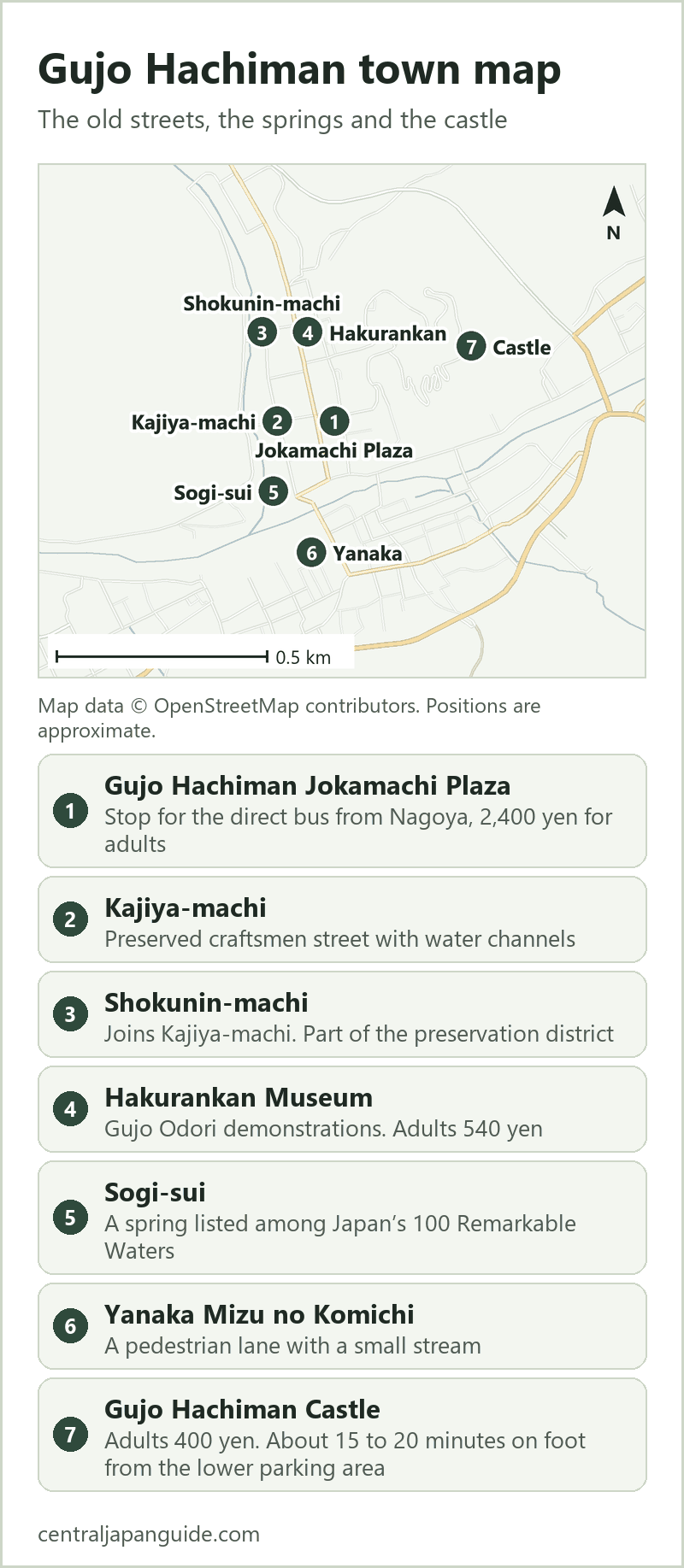
Open these places in Google Maps:
- Gujo Hachiman Jokamachi Plaza
- Gujo Hachiman Castle
- Hakurankan Museum
- Sogi-sui
- Yanaka Mizu no Komichi
Frequently asked questions
How do I get to Gujo Hachiman from Nagoya? Take the Gifu Bus highway bus from the Meitetsu Bus Center to Gujo Hachiman Jokamachi Plaza. The adult fare is 2,400 yen.
How much is Gujo Hachiman Castle? 400 yen for adults and 200 yen for children.
Can I make a food sample? Yes. Several makers offer workshops of about an hour. Book in advance.
When is the best time to see the autumn leaves? The official English page expects the peak from November 9 to 17, 2026, during the Momiji Festival.
Can I visit on the way to Takayama? Yes. Highway buses on the Nagoya to Takayama route stop at the Gujo Hachiman highway bus stop, and a reserved pick-up taxi runs to the town center for 350 yen.