Shirakawa-go Visitor Guide: Gassho Houses, Fees, Seasons and Practical Tips
Last checked: October 18, 2026, against the official Shirakawa-go Tourist Association website. Hours, fees and closing days change, so please confirm before you go. This site is independent and is not affiliated with Shirakawa-go or any facility. This post may contain affiliate links; if you book through them, we may earn a small commission at no extra cost to you.
Shirakawa-go is a mountain village in Gifu Prefecture, known for its gassho-zukuri farmhouses with steep thatched roofs. Together with Gokayama in Toyama Prefecture, it was registered as a UNESCO World Heritage Site in 1995. This guide covers what you can visit, what it costs, the practical details that surprise first-time visitors, and when to go. For the journey from Nagoya, see our Nagoya to Takayama and Shirakawa-go guide.
Key takeaways
- Walking around the village is free. Some houses charge about 300 to 400 yen to go inside.
- The official site says it takes roughly 2 to 3 hours to walk around the village.
- There are no trash cans in the village. Take your trash with you or return it to the shop where you bought it.
- Coin lockers at the bus terminal are open from 8:00 to 17:00.
- It snows heavily from late December to late February. The official site says autumn leaves are best from the end of October to the beginning of November.
The short version
| Question | Answer |
|---|---|
| Entry to the village | Free to walk around |
| Time to allow | About 2 to 3 hours on foot |
| Houses you can enter | Wada House, Nagase House, Kanda House and the Open-air Museum |
| Transport inside the village | No sightseeing bus. Everything is within walking distance |
| Observation deck shuttle | 200 yen one way, cash only |
| Trash cans | None in the village |
| Luggage | Coin lockers at the bus terminal. 8:00 to 17:00 |
All details are from the official Shirakawa-go Tourist Association site on the date above.
Houses you can enter
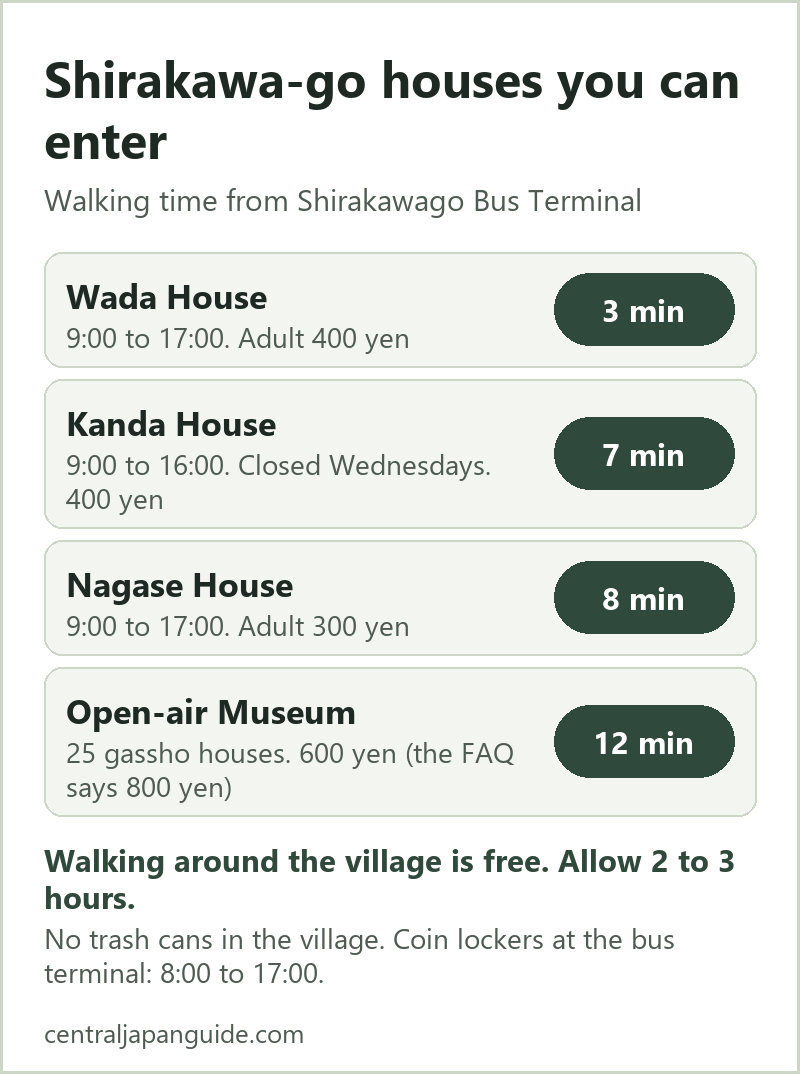
Many gassho houses are people’s homes. The official site lists these facilities that welcome visitors. Walking times are from Shirakawago Bus Terminal.
| Facility | Walk | Hours | Admission | Closed |
|---|---|---|---|---|
| Wada House | 3 minutes | 9:00 to 17:00 | Adult 400 yen, child 200 yen | Irregular |
| Kanda House | 7 minutes | 9:00 to 16:00 | Adult 400 yen, child 200 yen | Every Wednesday (open if a national holiday) |
| Nagase House | 8 minutes | 9:00 to 17:00 | Adult 300 yen, child 150 yen | Irregular |
| Open-air Museum | 12 minutes | March to November 8:40 to 17:00, December to February 9:00 to 16:00 | Adult 600 yen, child 400 yen | December to March: Thursdays |
- Wada House. The official site calls it the largest gassho-zukuri house in Shirakawa-go and a National Important Cultural Property. The first and second floors are open. The history is explained in Japanese on the first floor and in English on the second. Payment is cash only.
- Nagase House. The tallest gassho house, with five floors. It has a Buddhist altar said to be 500 years old.
- Kanda House. The official page highlights the internal structure of the roof, and the place under the floor where gunpowder was made.
- Open-air Museum. It has 25 gassho houses, 9 of them designated as prefectural important cultural properties, plus a watermill, a shrine and temple halls. Warm tea is served by the hearth. One note: the facility page lists 600 yen for an adult, while the official FAQ says 800 yen, so please check the current fee at the entrance.
The official site also lists the Gassho Architecture Museum at the Shirakawago Road Station, which has no admission fee, and the Myozenji Museum, which the official site describes as the largest temple in the village.
Getting around the village
- There is no sightseeing bus. The official FAQ says you can only sightsee on foot, and that all sights are within walking distance.
- Observation deck shuttle. The FAQ describes a shuttle to the observation deck, departing in front of Wada House at about 00, 20 and 40 minutes past the hour, and returning at 10, 30 and 50 minutes past. It runs from 10:00 to 14:40, with a break at 12:00 and service resuming from 13:00. The fare is 200 yen one way, in cash on the bus. Check the official site for the current schedule.
Practical tips
- No trash cans. The official FAQ says there are none, to protect the scenery. Return trash to the shop where you bought the item, or take it home.
- Luggage. Coin lockers at Shirakawago Bus Terminal are available from 8:00 to 17:00. Small and medium lockers are 500 yen per use, and large lockers are 1,000 yen. There is also a luggage storage service next to the bus terminal, until 17:00.
- Rain. Umbrellas and raincoats are sold at the bus terminal for 500 yen each.
- People live here. The official site explains that residents agreed on three principles for the village: not to sell, not to rent and not to destroy the houses. Please be respectful when walking near homes.
When to go
- Spring. The official FAQ says cherry blossoms bloom around the second week of April.
- Autumn. The best time for autumn leaves is the end of October to the beginning of November. The official site notes that exact dates depend on the temperature each year.
- Winter. The first snowfall in recent years has been around early December, and snow keeps accumulating from late December to late February. The site says snow in February can reach 170 cm or more. If you drive, studless tires are required on the slippery roads, and 4WD is recommended.
Winter light-up
The official site says the light-up event is held in January and February, and the dates change every year. For 2027, the 41st light-up is planned for January 11, 17, 24 and 31. The site says parking reservations for ordinary cars in the first round were sold out, and accommodation booked through the tourist association is allocated by lottery. Check the official event page for the latest details before you plan a winter trip.
Hot spring
Shirakawago-no-Yu is about a 2-minute walk from the bus terminal. It is open from 7:00 to 21:30 (last entry 21:00) and costs 900 yen for adults and 500 yen for children aged 4 to 12, according to the official site. The sauna has shorter hours on weekdays.
Getting here
There is no train to Shirakawa-go, so you must come by bus. Our Nagoya to Takayama and Shirakawa-go guide explains the direct bus from Nagoya, the Nohi Bus from Takayama, the reservation rules, and a realistic day trip plan. For the town of Takayama, see our separate guide. If you continue to Kanazawa, see our Kanazawa guide.
If you come from Takayama on the Nohi Bus, Klook sells a ticket for the buses that do not need a reservation.
Map
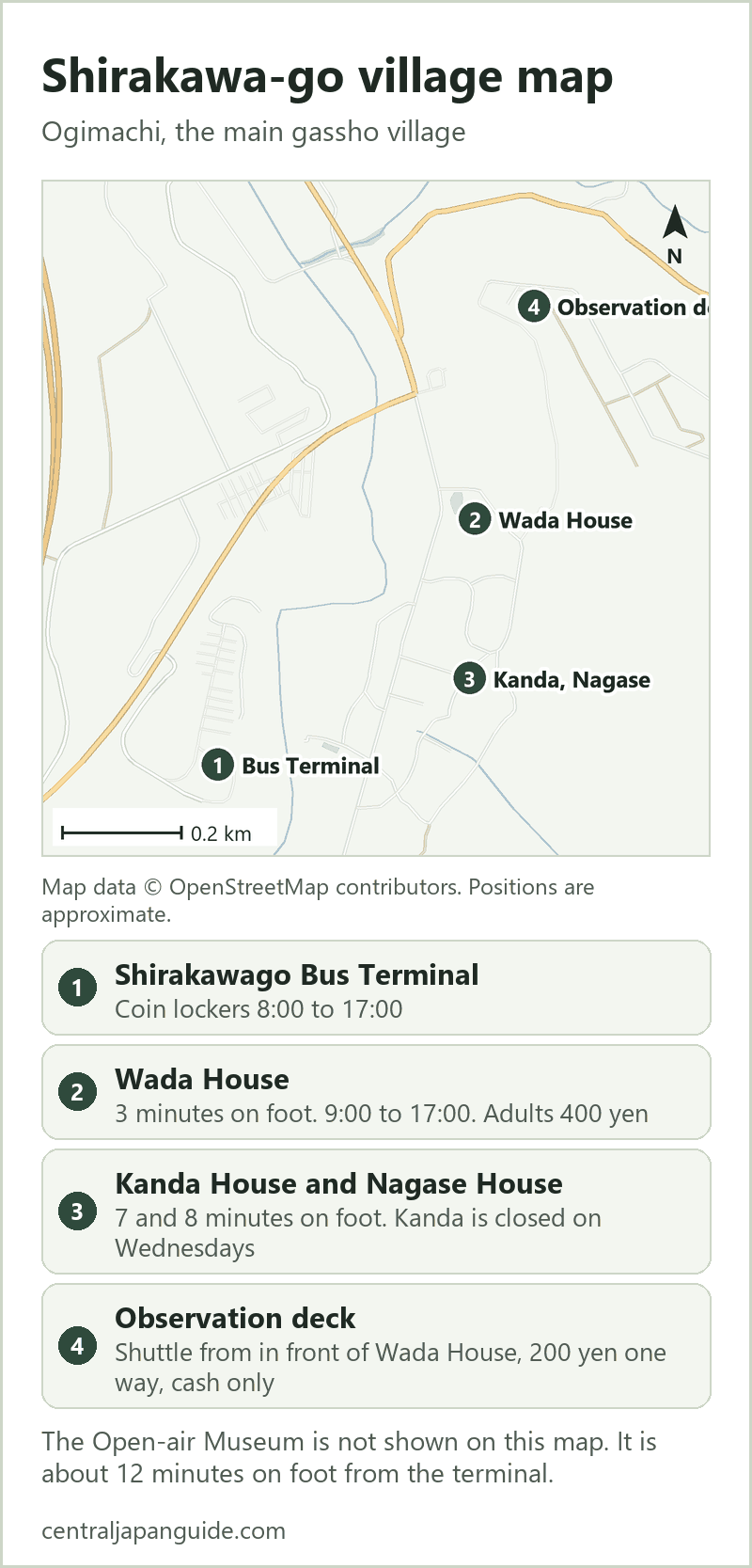
Open these places in Google Maps:
Frequently asked questions
How long do I need in Shirakawa-go? The official site says it takes roughly 2 to 3 hours to walk around the village.
Is it free to enter Shirakawa-go? Walking around the village is free. Visiting inside some facilities costs about 300 to 400 yen per person, and the Open-air Museum costs more.
Is there a bus inside the village? No sightseeing bus. A shuttle runs only to the observation deck, for 200 yen one way.
Can I store my luggage? Yes. There are coin lockers at the bus terminal from 8:00 to 17:00.
When is the best time to visit? Cherry blossoms are around mid April, the autumn leaves are from the end of October to the beginning of November, and winter brings heavy snow and the light-up events in January and February.