Gifu Day Trip from Nagoya: Gifu Castle (Closed for Renovation), the Ropeway and Cormorant Fishing
Last checked: November 3, 2026, against the official Gifu City tourism site (Gifu Tourism and Convention Association, Japanese) and a route planner for the train. Hours, fares and closures change, so please confirm before you go. This site is independent and is not affiliated with Gifu City or any operator. This post may contain affiliate links; if you book through them, we may earn a small commission at no extra cost to you.
Gifu is only about 20 minutes from Nagoya by JR. It is the city of Oda Nobunaga, who made it his base, and it has a castle on a mountain, a ropeway, and a river where cormorant fishing has been practiced for about 1,300 years. One important thing has changed: the main keep of Gifu Castle is closed for renovation, and it is not expected to reopen until November 2027. This guide explains what you can still see, and what is seasonal.
Key takeaways
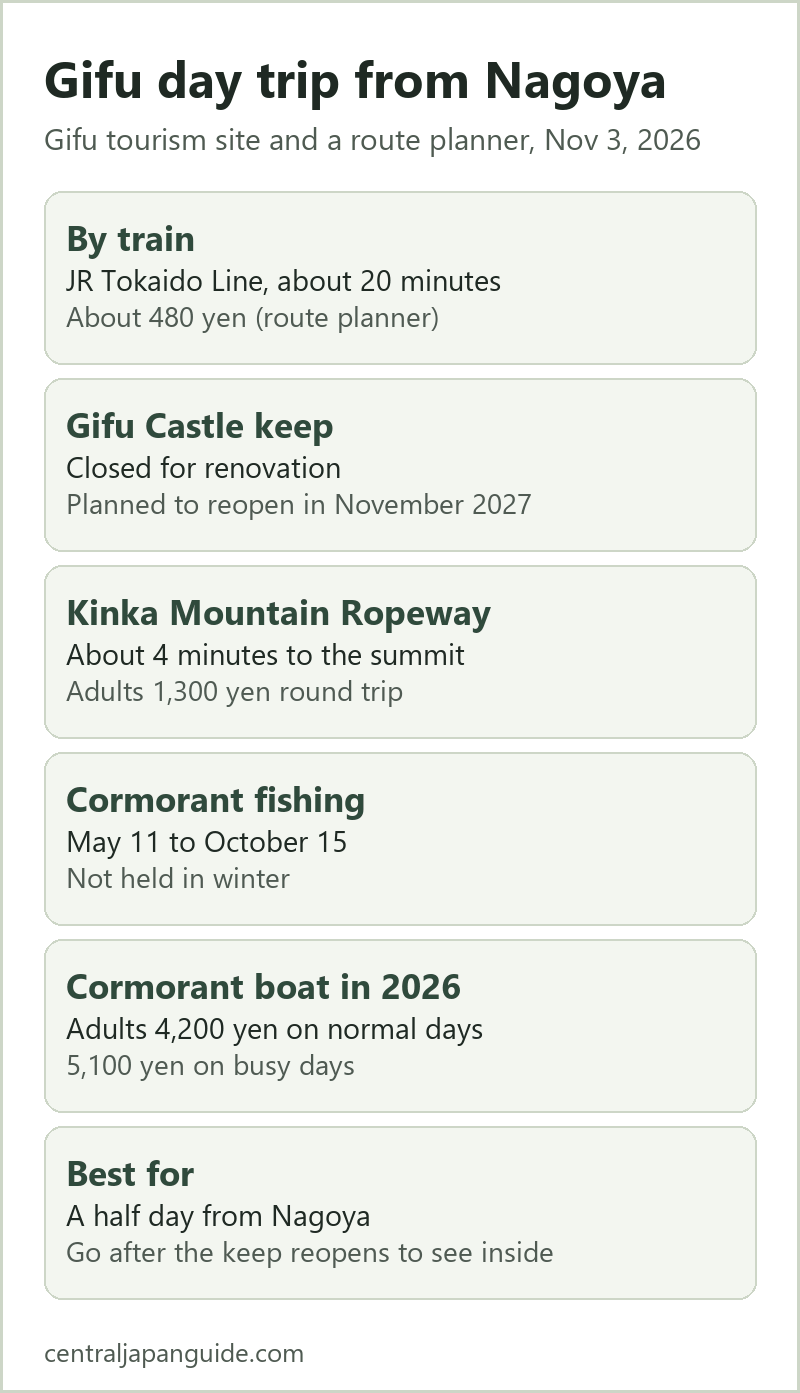
- The JR Tokaido Line takes about 20 to 26 minutes from Nagoya Station to Gifu Station, and a route planner lists 480 yen.
- The main keep of Gifu Castle is closed. The official site says it is scheduled to reopen in November 2027.
- The Kinka Mountain Ropeway still runs. The adult fare is 1,300 yen round trip, or 800 yen one way. The ropeway is a 4-minute ride.
- Cormorant fishing on the Nagara River runs from May 11 to October 15 each year, so it is not on in winter.
- Gifu works as a half-day trip, and it fits well after a morning in Nagoya.
Getting there from Nagoya
Take the JR Tokaido Line from Nagoya Station to Gifu Station. A route planner (Yahoo! Transit, for a weekday morning) lists 20 minutes on the special rapid train, 21 to 26 minutes on others, and 480 yen with an IC card, with no transfer. This is a route-planner result, not an official fare, so please confirm on the day. See our Nagoya Station transfer guide for how to find the JR platforms.
The Gifu City tourist information center is on the second floor of JR Gifu Station. The association lists it as open from 8:30 am to 7:30 pm every day, with the phone number 058-262-4415.
From Gifu Station, the sights below are reached by local bus. The official site says buses run from JR Gifu or Meitetsu Gifu Station. To the cormorant-boat landing, take a Gifu Bus toward Gifu Park for about 16 minutes (250 yen one way) and get off at Nagarabashi-minami or Kawaramachi. To Gifu Park and the castle, the official Rakuichi page says the bus from Meitetsu Gifu Station takes about 12 minutes to the Gifu Park stop.
Gifu Castle: closed for renovation
The castle stands on top of Mt. Kinka. According to the official site, Oda Nobunaga took the castle in 1567 and renamed the area from Inokuchi to Gifu. The current building was rebuilt in 1956.
- The keep is closed. The official page says the castle keep is currently closed, with the renewal opening planned for November 2027. It adds that visitors could enter until May 18, 2026.
- A trail closure. From November 25, 2025 to the end of September 2027 (planned), the area in front of the keep on the summit is closed to traffic. Some mountain trails end just short of the summit and cannot reach the castle or the summit toilets.
- Night lighting. The castle is lit from sunset until 11:00 pm, so you can still see it from below.
If seeing the inside of the castle is your main reason to go, wait until after it reopens. The mountain, the ropeway and the town are still worth a visit.
Kinka Mountain Ropeway
The ropeway links Gifu Park and the summit station in about 4 minutes. The official site says the view takes in Mt. Kinka’s natural forest, the Nagara River and the city.
- Fare. Adults aged 12 and over pay 1,300 yen round trip and 800 yen one way. Children aged 4 to under 12 pay 650 yen round trip and 400 yen one way.
- Hours. The first car up leaves at 9:00 am, and the last car down is at 6:00 pm. The last ride up is 30 minutes before the last car down. The official page lists later hours on summer nights and on some autumn and spring weekends, so check the schedule for your date.
- At the top. The official page lists a squirrel village, shops and an observation restaurant near the summit station. The restaurant has different hours on weekdays and on weekends and holidays. The squirrel village charges a separate entry fee, so check it on the day.
Cormorant fishing on the Nagara River
The official site describes Nagara River cormorant fishing as a method with about 1,300 years of history. The river’s six official cormorant masters carry on the technique, and the fishing gear and the technique are designated national cultural properties.
- Season. Every year from May 11 to October 15, except for one rest day around the mid-autumn full moon and days when the water is too high. It is not held in winter.
- Start. The fishing starts at 7:45 pm. Events may change the time.
- Boats. Shared boats leave at 6:15 pm, 6:45 pm and 7:15 pm.
- Prices (2026). Shared boat, normal days: adults 4,200 yen and children 2,100 yen. Busy days: adults 5,100 yen and children 2,600 yen. Adults are junior high school students and older. Children are aged 3 and over, up to elementary school. Prices for 2027 were not on the page when we checked.
- Reservations. The Gifu City Cormorant Fishing Boat Office takes reservations, and the phone number on the official page is 058-262-0104.
- If you come in winter. The Nagaragawa Cormorant Fishing Museum (Gifu City Nagara River Ukai Denshokan) is on the official list of sights, but we did not check its hours.
Other places in town
The official list of sights also includes these places, which we did not check in detail.
- Gifu Castle Rakuichi. Seven single-story wooden buildings with 11 shops, according to the official page. Hours and closing days differ by shop. A food and shopping stop near Gifu Park.
- Kawaramachi old streets. The old merchant streets by the river.
- Gifu Great Buddha (Shohoji). One of the temples on the list.
- Gold statue of Oda Nobunaga. Listed among the sights.
- Gifu City History Museum, Gifu Park and Nagaragawa Onsen. All are on the official list.
A half-day plan
This is our suggestion, not an official route. Check the hours for your day.
1. Take a morning JR train from Nagoya to Gifu, which takes about 20 minutes. 2. Take the bus to Gifu Park (about 12 minutes from Meitetsu Gifu Station, according to the official page). 3. Ride the ropeway to the summit and see the squirrel village and the view. The keep is closed. 4. Come down, walk through Gifu Castle Rakuichi for lunch, and then walk to the river and Kawaramachi. 5. Return to Nagoya by JR.
In summer, you can end the day with a cormorant fishing boat, but plan to return by train late. See the last train time before you book.
Practical tips
- Check the ropeway’s operating hours for your date. The last ride up is earlier than the last ride down.
- Expect a trail closure near the summit. The official site lists it until about the end of September 2027.
- In summer, book the cormorant boat in advance, by phone or through the boat office.
- Gifu works well as an add-on to a Nagoya stay of two or more days. See our 3-day Nagoya itinerary.
Frequently asked questions
How long does it take from Nagoya to Gifu? About 20 to 26 minutes on the JR Tokaido Line, according to a route planner.
Can I go inside Gifu Castle? Not now. The keep is closed for renovation and is scheduled to reopen in November 2027, according to the official site.
Is the ropeway open? Yes. The adult fare is 1,300 yen round trip, and the ride takes about 4 minutes.
When is cormorant fishing held? Every year from May 11 to October 15, except on one rest day and when the river is high. It is not held in winter.
How much does a cormorant boat cost? In 2026, 4,200 yen for adults on normal days and 5,100 yen on busy days. We did not find 2027 prices.
Sources
- Gifu Tourism and Convention Association: Gifu Castle (Japanese)
- Gifu Tourism and Convention Association: Kinka Mountain Ropeway (Japanese)
- Gifu Tourism and Convention Association: Nagara River cormorant fishing (Japanese)
- Gifu Tourism and Convention Association: Gifu Castle Rakuichi (Japanese)
- Gifu Tourism and Convention Association: Sightseeing spots (Japanese)
- Yahoo! Transit: Nagoya to Gifu (Japanese)