Gero Onsen from Nagoya: Day-Trip Guide to Public Baths, Foot Baths and the Direct Bus
Last checked: October 31, 2026, against the Gero Onsen Tourism Association website, the Gero Onsen Ryokan Cooperative Association website, the Japan National Tourism Organization (JNTO) page on Gero Onsen, and a route planner for fares. Hours, fees and bus schedules change, so please confirm before you go. This site is independent and is not affiliated with any bath, inn or transport operator. This post may contain affiliate links; if you book through them, we may earn a small commission at no extra cost to you.
Gero Onsen is one of the three most famous hot spring towns in Japan, and it is about an hour and a half from Nagoya by train. That makes it one of the easiest places to try a real onsen town without staying overnight. This guide covers how to get there, which public baths a day visitor can use, what is free, and one thing that has changed: the open-air Funsen-chi pool beside the river can no longer be used for bathing.
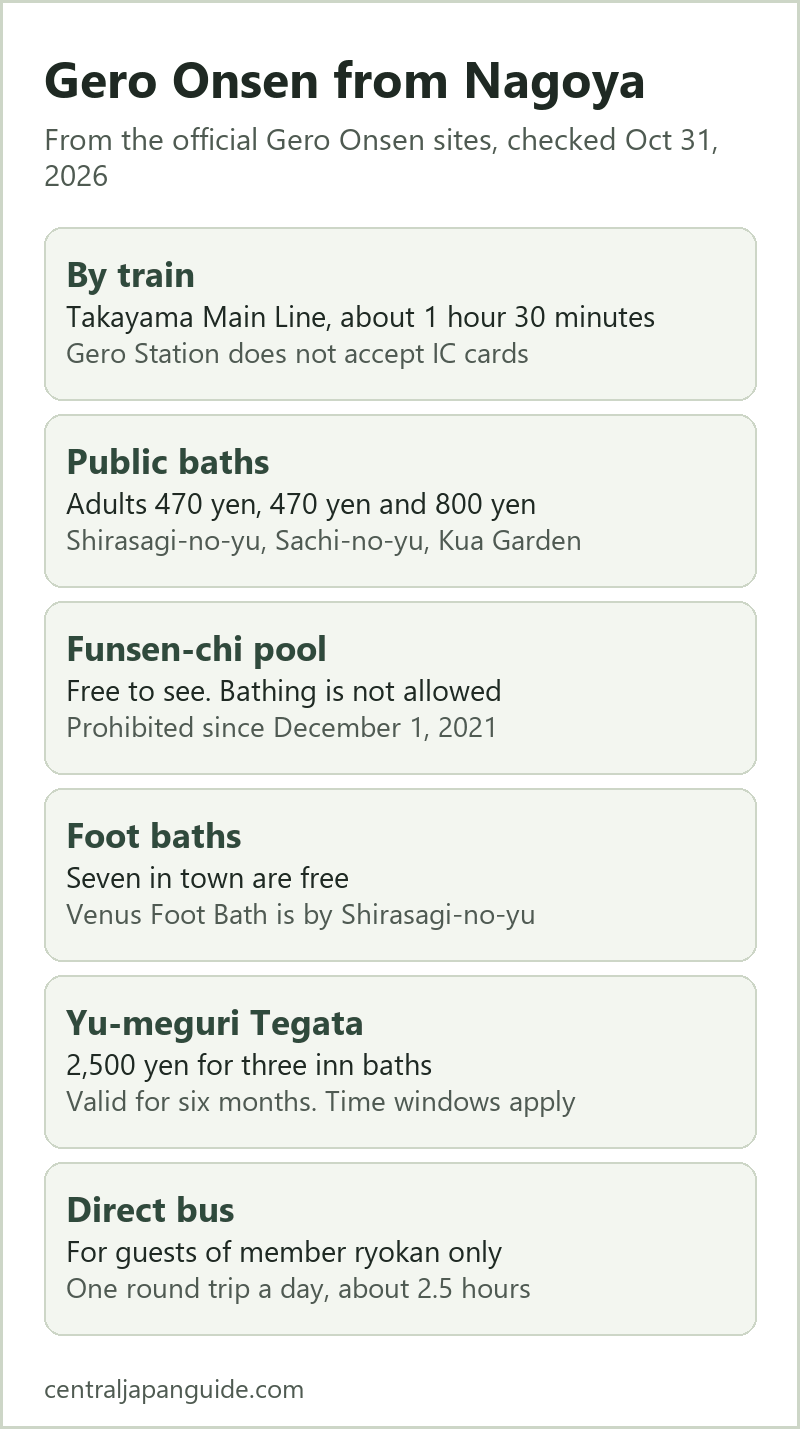
Key takeaways
- From Nagoya Station, the Takayama Main Line takes about 1 hour 30 minutes to Gero Station, according to the Gero Onsen Tourism Association. JNTO gives 1 hour 45 minutes for the Hida limited express.
- The water is a simple alkaline spring with a pH of 9.2. The town calls it a “beauty spring” for its smooth feel.
- Day visitors can use three public baths. Adult fees are 470 yen at Shirasagi-no-yu and Sachi-no-yu, and 800 yen at Kua Garden Open-Air Bath.
- The Funsen-chi open-air pool is free to see, but bathing there has been prohibited since December 1, 2021.
- Seven foot baths in town are free. The Yu-meguri Tegata pass is 2,500 yen for baths at three member inns.
- There is a direct bus from Nagoya, but it is only for guests staying at member ryokan.
What Gero Onsen is
The tourism association says Gero Onsen is about 1,000 years old and is counted as one of the “three famous hot springs” of Japan, together with Arima in Hyogo and Kusatsu in Gunma. The water is a simple alkaline hot spring with a pH of 9.2. The town says it has a natural soap-like effect that makes the water feel smooth, which is why it is nicknamed the “beauty spring.”
The association lists the discovery of the spring on Mt. Yugamine in the Tenryaku era (947 to 957), and says that around 1265 the spring stopped flowing on the mountain and reappeared in the Hida River. This is known as the “White Heron legend.” A Kyoto monk named Manri Shukyu praised the spring in 1489, and his poetry collection named Gero one of the top three springs.
The town has more than 50 inns and hotels. For a day trip you do not need one. Public baths, foot baths and the museums are all within a short walk of Gero Station.
Getting there from Nagoya
By train
The Takayama Main Line runs from Nagoya Station to Gero. The Hida limited express is the fastest.
- Time. The Gero Onsen Tourism Association says about 1 hour 30 minutes from Nagoya Station to Gero Station. JNTO says 1 hour 45 minutes on the JR Hida Express. Allow about 1 hour 45 minutes.
- Fare. We could not find a Nagoya to Gero fare on JR Central’s own pages. A route planner showed 2,310 yen for the basic fare and 1,860 yen for the unreserved limited express surcharge, a total of 4,170 yen one way. A reserved seat costs more. Please check with JR Central or a route planner before you buy.
- Reserved or not. The limited express usually has both reserved and unreserved seats. During peak periods set by JR Central, all seats are reserved. Check the calendar.
- IC cards. The tourism association says Gero Station does not accept transit IC cards such as TOICA. Buy a ticket that covers the whole trip before you board.
A cheaper way
A route planner shows a cheaper path: Meitetsu Nagoya Station to Shin-Unuma on the Meitetsu Inuyama Line, then the JR Takayama Main Line local train from Unuma to Gero. The planner gave 690 yen plus 1,340 yen, a total of 2,030 yen, and 2 hours 13 minutes. This is a route-planner result, not an official fare, so confirm it on the day.
By direct bus
The Gero Onsen Ryokan Cooperative Association runs a direct bus. It is useful, but it has a big restriction.
- Who can use it. Only guests staying at member ryokan. If you are not staying overnight, you cannot book it.
- Schedule. One round trip a day. It leaves JR Nagoya Station (Taikomichi exit) at 14:00 and arrives in Gero at about 16:30. From Gero, it leaves at 10:30 and arrives in Nagoya at about 13:00. It takes about 2.5 hours.
- Fares. For departures until November 30, 2026, the round trip is 4,500 yen and one way is 3,300 yen. From December 2026 to March 2027, the round trip is 5,000 yen and one way is 3,800 yen.
- Booking. Reservations open 2 months before the date and close 2 days before departure. A minimum of 2 passengers is needed.
The page also shows a banner with a different round-trip figure, so confirm the fare when you book.
The three public baths
All three are in the town center. The details below come from the Gero Onsen Tourism Association’s spot pages, which gave current fees. An older city page (updated in 2020) lists different prices, so we use the association’s figures.
Shirasagi-no-yu
- What it is. A public bath housed in a white, Romanesque-style building, with a cypress indoor bath and a rest area. Outside the entrance is the Venus Foot Bath.
- Fee. Adults 470 yen, elementary school students 180 yen, young children 100 yen.
- Hours. 10:00 to 20:45, with last entry at 20:00.
- Closed. Wednesdays. If Wednesday is a holiday, it is closed on Friday instead.
- From the station. About 7 minutes on foot.
- Parking. 7 spaces, free.
Kua Garden Open-Air Bath
- What it is. A health-oriented bath facility with an open-air bath where you can hear the Hida River, and six kinds of spa baths, including a spray bath, a steam box and a bubble bath.
- Fee. Adults 800 yen, elementary school students 400 yen, young children 200 yen.
- Hours. 8:00 to 20:45, with last entry at 20:00.
- Closed. Thursdays. If Thursday is a holiday, it is closed the next day.
- From the station. About 10 minutes on foot.
Sachi-no-yu
- What it is. A public bath attached to the Sachi-no-yu inn, with seven kinds of baths including a spray bath and an open-air bath.
- Fee. Adults 470 yen, elementary school students 180 yen, young children 100 yen.
- Hours. On weekdays, 12:00 to 21:00, with last entry at 20:30. On weekends and holidays, 11:00 to 21:00, with the same last entry.
- Closed. Tuesdays, and the fourth Monday of the month.
- From the station. About 4 minutes on foot.
- Family baths. The page says all family baths are currently suspended.
- Parking. 20 spaces, free.
If this is your first onsen, read our onsen etiquette guide first. The rules in public baths are the same as in any other: wash before you enter, keep towels out of the water, and no swimsuits.
Funsen-chi: look, but do not bathe
Funsen-chi is an open-air pool of spring water beside the Hida River, with no walls around it. It is one of the town’s best-known sights. The tourism association says it is free and open all year. It also says that since December 1, 2021, bathing there has been prohibited. Some older travel pages still describe it as a bathing spot, so do not rely on them. Viewing it is fine, and it is about 3 minutes on foot from the station.
Foot baths
The tourism association says seven of the foot baths in town are free. Two more, at Gero Gassho Village and the Gero Hatsu Onsen Museum, need an admission ticket. Two examples:
- Venus Foot Bath. A round foot bath with a Venus statue, in front of Shirasagi-no-yu. It seats 12 people. It is free, with the same hours as the bath (10:00 to 20:45), and is closed on Wednesdays.
- Foot baths elsewhere. The association’s list includes the Saginoashi foot bath (a roofed bath for five), the Miyabi foot bath, the Yuami-ya foot bath, where you can boil eggs in the hot spring water, and the Tano-kami foot bath beside the city hall annex.
A foot bath is a good way to try the water if you are short on time. Bring a small towel.
Yu-meguri Tegata: a three-bath pass
The Gero Onsen Ryokan Cooperative Association sells a wooden “Yu-meguri Tegata” pass for 2,500 yen, including tax. It lets you bathe at three member inns of your choice. It is valid for six months from purchase, and the association says it also makes a good souvenir.
- Children. Children aged 3 and under bathe free. Children aged 4 to 12 can bathe with an adult, but they need a sticker from the pass, so it is not free. Junior high students and older are treated as adults.
- Time windows. Each inn accepts the pass only at certain times, mostly in the afternoon or early evening. Some do not allow it on weekends or holidays, and some do not accept the pass for car users because they have no parking.
- Public baths. The association’s list also shows Shirasagi-no-yu and Kua Garden with their open hours.
The pass can be a good deal if you want to see several inn baths. For one or two baths in a day, the public baths are cheaper. Check the time windows on the association’s page first.
Gero Onsen Gassho Village
Gassho Village is an open-air museum of old farmhouses, about 20 minutes on foot from Gero Station. It has 10 gassho-style farmhouses, including the Former Ohto House, which was moved from near Shirakawa-go. The association says the house is a nationally designated Important Tangible Folk Cultural Property.
- Admission. Adults 800 yen, elementary and junior high students 400 yen.
- Hours. 8:30 to 17:00. On December 31, January 1 and January 2, the hours are 9:00 to 16:00. Open every day of the year.
- Getting there. About 20 minutes on foot from the station, or about 6 minutes by Nohi Bus to the “Gassho-mura” stop.
- Parking. 200 spaces, free for visitors.
- Activities. Pottery and washi paper-making workshops, and a shadow-play theater. The association says it is the only permanent shadow-play theater in Japan.
If you are going to Shirakawa-go, see our Shirakawa-go guide. Gassho Village is a smaller option if you cannot get there.
Gero Hatsu Onsen Museum
A small museum about hot springs, with exhibits on the science and culture of onsen. It has a walking foot bath. Admission is 400 yen for adults (junior high and older) and 200 yen for elementary students. Hours are 9:00 to 17:00. It is closed on Thursdays (the next day if Thursday is a holiday) and from December 29 to 31. It is about 8 minutes on foot from the station.
A day-trip plan
Our suggestion, not an official route. Check last entry times before you go.
1. Take the Hida limited express from Nagoya Station in the morning. 2. Reach Gero Station and walk to Funsen-chi to see the river-side spring pool. 3. Eat lunch in town, then soak your feet at the Venus Foot Bath. 4. Bathe at Shirasagi-no-yu or Kua Garden. Sachi-no-yu opens later in the day on weekdays. 5. If you have time, go to Gassho Village by bus or on foot. 6. Take a train back to Nagoya. Check the last train time, because the trip is about an hour and a half.
If you want a quieter experience, avoid weekends and national holidays.
If you are staying in Takayama
This tour starts in Takayama, not Nagoya. It is only useful if you are already staying in Takayama and want a guided day in Gero.
Staying overnight
Gero has more than 50 inns and hotels. If you stay at a member ryokan of the Gero Onsen Ryokan Cooperative Association, you can use the direct bus from Nagoya. If this is your first night in a Japanese inn, see our ryokan etiquette guide.
Practical tips
- Bring a small towel. Check at each bath whether you can rent or buy one.
- Public bath hours differ by day, and each bath has a different closing day. Wednesday and Thursday are closing days for Shirasagi-no-yu and Kua Garden, so plan around them.
- Tattoo policies vary. Ask before you go. The sources we checked did not say whether the public baths allow tattoos.
- Check the last train back to Nagoya before you start soaking.
Frequently asked questions
How long does it take from Nagoya to Gero? About 1 hour 30 minutes on the Takayama Main Line, according to the Gero Onsen Tourism Association. JNTO says 1 hour 45 minutes on the Hida express.
Can I use a transit IC card at Gero Station? The tourism association says Gero Station does not accept transit IC cards such as TOICA. Buy a ticket in advance.
Can I bathe in Funsen-chi? No. Bathing has been prohibited since December 1, 2021. You can see it for free.
Is there a free public bath? No. The three public baths charge 470 yen to 800 yen. The foot baths in town are free.
Can I take the direct bus from Nagoya without staying overnight? No. The direct bus is only for guests of member ryokan.
Is the Yu-meguri Tegata worth it? It costs 2,500 yen for three inn baths and is valid for six months. It makes sense if you want to try several inn baths. For one or two baths, the public baths are cheaper.
Sources
- Gero Onsen Tourism Association: Shirasagi-no-yu (Japanese)
- Gero Onsen Tourism Association: Kua Garden Open-Air Bath (Japanese)
- Gero Onsen Tourism Association: Sachi-no-yu (Japanese)
- Gero Onsen Tourism Association: Funsen-chi (Japanese)
- Gero Onsen Tourism Association: Gero Onsen Gassho Village (Japanese)
- Gero Onsen Tourism Association: Gero Hatsu Onsen Museum (Japanese)
- Gero Onsen Tourism Association: Gero Onsen overview (Japanese)
- Gero Onsen Ryokan Cooperative Association: Yu-meguri Tegata (Japanese)
- Gero Onsen Ryokan Cooperative Association: Direct bus from Nagoya (Japanese)
- JNTO: Gero Onsen