Ryokan Etiquette: How to Stay at a Japanese Inn, Step by Step
Last checked: October 29, 2026, against the official Aichi Now travel guide page on ryokan etiquette, the Visit Kanagawa page on accommodation manners, the Japan National Tourism Organization (JNTO) page on Japanese manners, and the English pages of the Japan Ryokan & Hotel Association. These pages do not give dates, and each ryokan has its own rules, so always follow the instructions of the inn and its staff. This site is independent and is not affiliated with any ryokan or tourism office. This post may contain affiliate links; if you book through them, we may earn a small commission at no extra cost to you.
A ryokan is a traditional Japanese inn, with tatami rooms, futon bedding, a yukata robe and often a hot spring bath. Many visitors want to stay in one, and many worry about doing something wrong. The good news is that the rules are few, and the staff are used to first-time guests. This guide follows a stay in order, with illustrations, and notes which points come from official tourism pages and which are only common practice.
Key takeaways
- Take off your shoes at the entrance, then put on the slippers provided. Take the slippers off before you step onto the tatami.
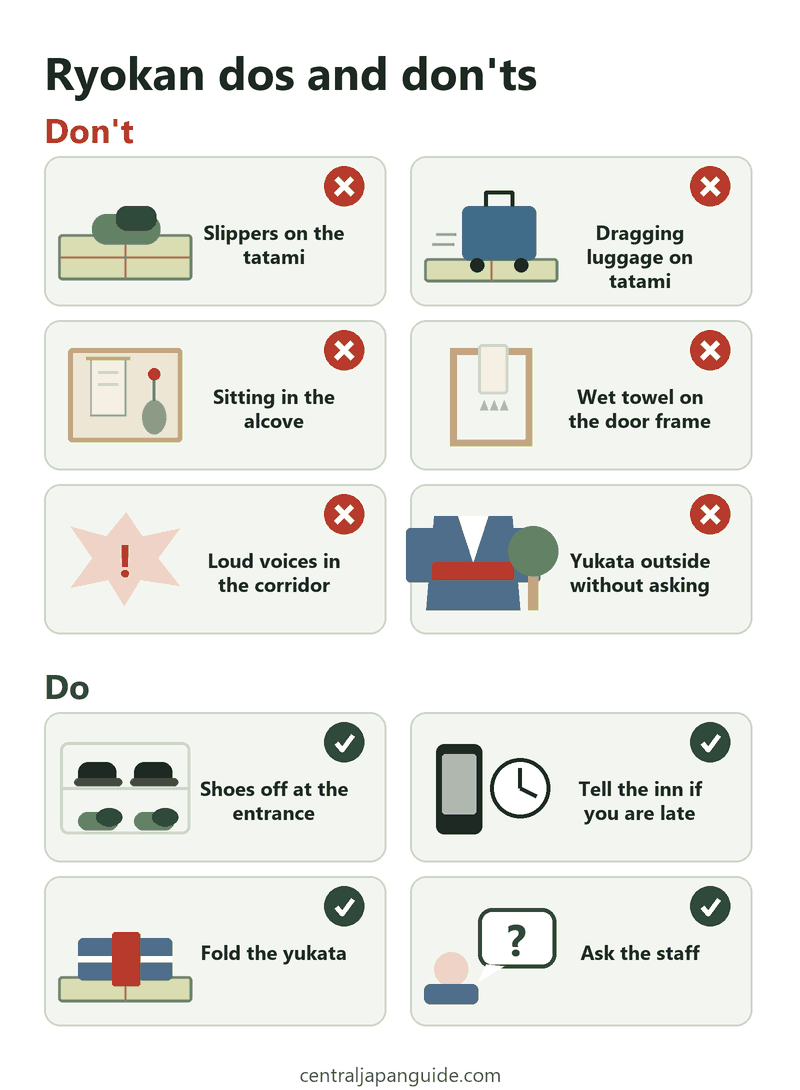
- Do not drag luggage across the tatami, and do not sit in or put things in the decorated alcove (tokonoma).
- The yukata is usually provided. Wear it with the left side over the right. Whether you may go outside in it depends on the inn, so ask.
- Meals may be served in your room, in a dining hall or in a separate restaurant. Staff lay out the futon for you.
- Follow your reserved check-in and check-out times, and tell the inn in advance if you will be late.
- A ryokan charges for one night with two meals, dinner and breakfast, per person, according to the Japan Ryokan & Hotel Association.
- The association says the most common check-in hour is around three o’clock in the afternoon, and that check-out is at 10 or 11 in the morning at most ryokan.
Before you go
- Keep to your reserved times. The Visit Kanagawa page says it is important to follow the reserved check-in and check-out times, and to tell the accommodation in advance if you will be late. The Japan Ryokan & Hotel Association says the most common check-in hour is around three o’clock in the afternoon, and that it differs slightly from one ryokan to another. Check the time on your booking.
- Check the tattoo policy if you have one. Visit Kanagawa says bathing restrictions may apply if you have a tattoo, and asks you to check with the facility before bathing. JNTO says tattoos are generally not permitted in hot springs and public baths. A private bath is one alternative. See our onsen etiquette guide for more.
- Tipping. JNTO says tipping is not expected at Western-style hotels in Japan. I did not find an official statement about ryokan, so if you are unsure, ask the inn.
- Rules differ. Check with your ryokan about meal times, yukata use and anything else that matters to you.
How a ryokan is priced
The Japan Ryokan & Hotel Association says the biggest difference from a Western-style hotel is the fee system. A ryokan charges for “one night’s stay with two meals”, which are dinner on the day you arrive and breakfast the next morning. The charge is per person, not per room. The association says the average prices of its member ryokan range from 5,000 yen to 119,000 yen per person.
At most ryokan, meals are served in the guest room, which is called heya-shoku. At some, meals are taken in a large dining room or a private dining room. The association says most of its member ryokan accept major payment cards, and advises you to confirm this when you make the reservation.
Step by step
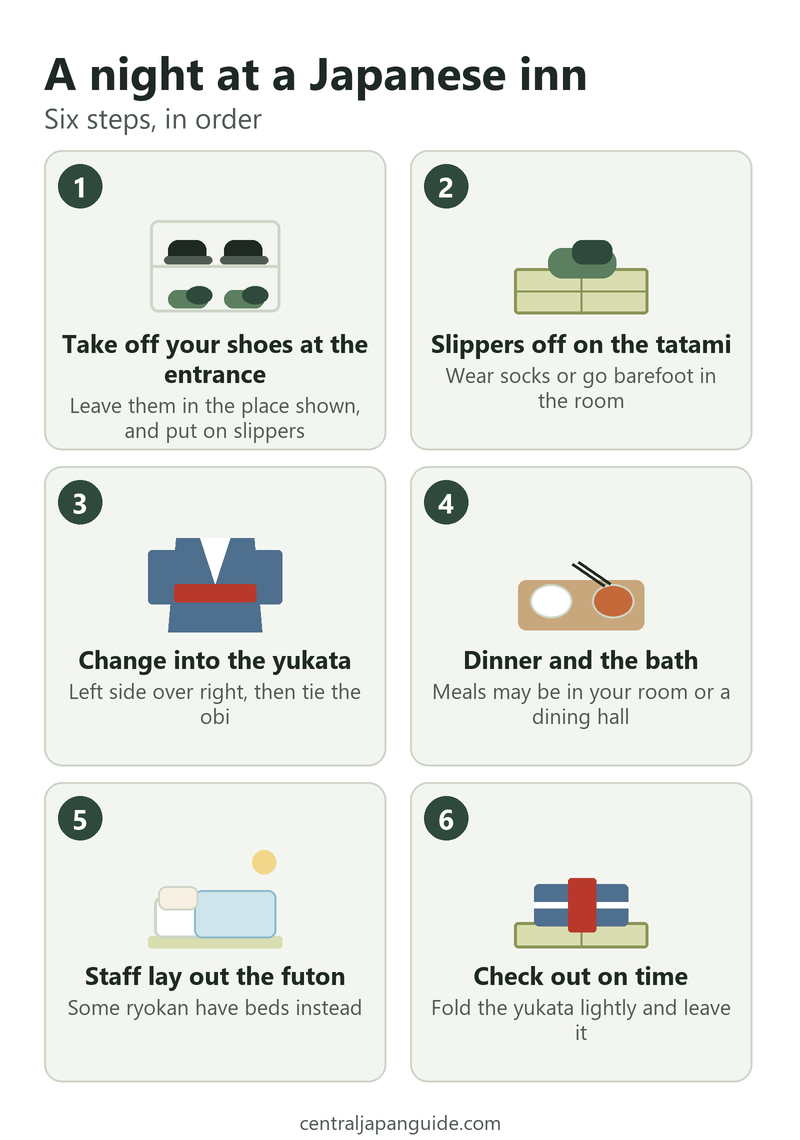
1. At the entrance
Take off your shoes at the entrance area inside the doorway, and leave them in the place shown, such as a shoebox. Indoor slippers are provided. A room attendant will usually show you to your room, though some ryokan ask guests to carry their own luggage. This comes from the Aichi Now page and the JNTO page.
The Japan Ryokan & Hotel Association adds that at some ryokan guests take off their shoes at the entrance and wear slippers, and at others guests may keep their shoes on up to the guest room. At some inns the corridors are covered with tatami mats, and you walk there without shoes or slippers. If you are not sure, ask at the entrance. With your consent, the room attendant, called Nakai-san, carries your luggage to the room and gives you a short tour on the way. Soon after you settle in, she brings tea and a sweet, and confirms the time for serving meals.
2. In the room
- Slippers. Do not wear slippers in the guest room. JNTO says it is customary to take slippers off when you are on the tatami. Most restrooms have a separate pair of slippers.
- Tatami. The mats are easily damaged when large luggage is dragged across them, so carry your bags.
- The alcove. Do not go into the decorated alcove (tokonoma), sit in it or put your luggage in it.
- Free tea and snacks. The Japanese tea and snacks in the room are free, according to the Aichi Now page.
- Wet towels. Do not hang wet towels over door frames, because this can cause mold.
- Noise. Do not run or make loud noises in the corridors.
3. The yukata
- Putting it on. A yukata is usually provided. Wear it with the left side over the right, and tie the obi (sash). Ask the staff if you need help. Wearing it loosely is bad manners, according to the Aichi Now page.
- In the cold season. The Japan Ryokan & Hotel Association says a thicker padded robe called a tanzen is provided to wear over the yukata, and a short jacket called a haori can go over either. Tabi (Japanese socks) and bath and face towels are also provided, depending on the season.
- Inside the ryokan. You can walk around inside in a yukata and slippers. Using a shop or restaurant inside the inn in a yukata is generally allowed, but check the rules with the staff first.
- Outside. The Aichi Now page says you cannot leave the building in a yukata and slippers. JNTO says yukata can sometimes be worn outside and sometimes not. So ask before you step out.
- Going to the bath. Change into your yukata and slippers in your room before you go to the bathhouse.
- When you leave. Do not take the yukata home. Fold it lightly and put the pieces together.
4. The bath
Men’s and women’s baths are generally separate. These points come from Visit Kanagawa and JNTO:
- Wash your body before you enter the bath.
- Keep your towel out of the water, and tie up long hair.
- Cell phone use is prohibited in the changing rooms and the bathing area.
- Wipe off the water with the small towel before you return to the changing room.
- The baths are for bathing, not for swimming.
The Japan Ryokan & Hotel Association says ryokan put great importance on their baths, and that a morning bath is a luxury unique to a ryokan. Many ryokan have a large shared bath, and some also have an open-air bath or a private open-air bath.
Our onsen etiquette guide has illustrations of the full order.
5. Dinner and breakfast
Dinner at a ryokan is generally a course menu of Japanese food made with seasonal ingredients. The Japan Ryokan & Hotel Association says that at most ryokan the meals are served in the guest room, and that the attendant explains each dish as she serves it. Depending on the ryokan, meals may also be served in a dining hall or in a separate restaurant. Dinner and breakfast may be in different places. If you are unsure, ask the staff, who are glad to help. The association does not give a standard dinner time, but says the room attendant confirms the time for serving meals with you after you settle into your room. Tell her if you need a different time, and follow the time your ryokan gives you.
6. Sleeping
Staff lay out the futon and store the bedding in the closet, and a staff member handles putting them away. Some ryokan have beds instead. Check with the inn if you have a preference.
7. Checking out
Check out at the reserved time. The Japan Ryokan & Hotel Association says that at most ryokan the check-out time is either 10 or 11 o’clock in the morning, and that the okami and her staff see you off at the entrance. Fold the yukata lightly and leave it. Staff will handle the futon.
Frequently asked questions
Do I take my shoes off? Yes. Take off your shoes at the entrance and use the slippers provided. Take the slippers off on the tatami.
Can I wear the yukata outside? It depends on the ryokan. The Aichi Now page says you cannot leave the building in a yukata and slippers, and JNTO says it is sometimes allowed. Ask first.
Can I take the yukata home? No. Fold it lightly and leave it.
Do I have to tip? JNTO says tipping is not expected at Western-style hotels. I did not find an official statement about ryokan, so ask your inn if you are unsure.
What time is dinner? No standard time is given on the pages I read. The Japan Ryokan & Hotel Association says the room attendant confirms the time for serving meals with you after you settle in. Follow the time your ryokan gives you.
What time do I check in and out? The association says the most common check-in hour is around three o’clock in the afternoon, and that check-out is at 10 or 11 in the morning at most ryokan. Check your booking, because each inn sets its own times.
What does the price include? One night’s stay with dinner and breakfast, charged per person, according to the association.
What if I have a tattoo? Bathing restrictions may apply. Check with the ryokan before you book, or ask about a private bath.
Sources
- Japan Ryokan & Hotel Association: Now You Stay in a Ryokan (with the Receiving Guests, To Your Guestroom, Yukata, Dinner, Comfortable Slumber and Checking-out pages)
- Japan Ryokan & Hotel Association: The Fee System & Prices
- Aichi Now: Etiquette for an enjoyable stay at a ryokan
- Visit Kanagawa: Accommodation manners
- JNTO: Understanding and mastering Japanese manners and etiquette