Ise Jingu Day Trip from Nagoya: Geku, Naiku, Oharaimachi and Getting Around
Last checked: October 20, 2026, against the official Ise Jingu website and the Ise City Tourism Association websites. Timetables, fares and shop hours change, so please confirm before you go. This site is independent and is not affiliated with Ise Jingu or any operator. This post may contain affiliate links; if you book through them, we may earn a small commission at no extra cost to you.
Ise Jingu, in Mie Prefecture, is one of the most important Shinto sites in Japan. It is a day trip from Nagoya by train, and it works well as a quiet change from the city. This guide covers how to get there, the order in which the official site suggests visiting, the opening hours, the manners to follow, and the old street of Oharaimachi.
Key takeaways
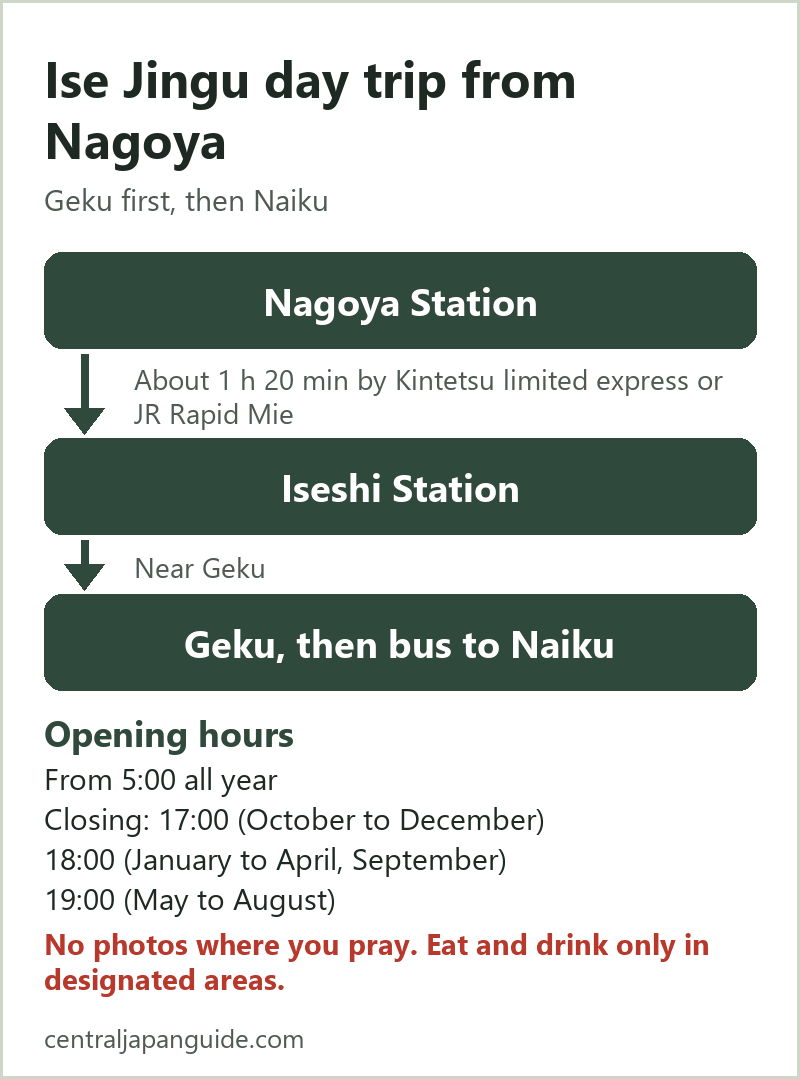
- From Nagoya Station, the Kintetsu limited express takes about 1 hour 20 minutes to Iseshi Station, according to the Ise City Tourism Association. The JR Rapid Mie is a little slower (about 1 hour 30 minutes on a travel information site, a secondary source).
- The official Ise Jingu site asks you to visit Geku first, and then Naiku.
- The precinct opens at 5:00. The closing time depends on the month: 17:00 from October to December, 18:00 in January to April and September, and 19:00 from May to August.
- Please do not take pictures at the place where you pray. Eating, drinking and smoking are allowed only in designated areas.
- Oharaimachi, the old street in front of Naiku, is about 800 meters long, and entry to Okage Yokocho is free.
The short version
| From Nagoya Station to Iseshi Station | About 1 hour 20 minutes by Kintetsu limited express (JR Rapid Mie: about 1 hour 30 minutes) |
| Geku address | 279 Toyokawa-cho, Ise City |
| Naiku address | 1 Ujitachi-cho, Ise City |
| Opening time | 5:00, all year |
| Closing time | 17:00 (October to December), 18:00 (January to April, September), 19:00 (May to August) |
| Order of the visit | Geku first, then Naiku |
The times and addresses come from the official Ise Jingu pages and the Ise City Tourism Association on the date above. The official pages do not give the train fare, so check the fare with Kintetsu or JR on the day.
What is Ise Jingu?
According to the official site, Ise Jingu, officially called “Jingu”, includes 125 shrines. Its center is Kotaijingu (Naiku), dedicated to Amaterasu-Omikami, and Toyo’uke-daijingu (Geku), dedicated to Toyo’uke-no-Omikami. The site says the area is roughly the size of central Paris, and that more than 1,500 rituals are held each year.
- Naiku. The official site says Amaterasu-Omikami was enshrined here about 2,000 years ago. Visitors are not permitted to enter the courtyard of the main palace, and pilgrims usually pray in front of the gate of the third fence. The Uji Bridge, more than 100 meters long, is at the entrance. It is rebuilt every twenty years as part of the Shikinen Sengu.
- Geku. The official site says Toyo’uke-no-Omikami was enshrined here about 1,500 years ago, as a provider of food and companionship for Amaterasu-Omikami. The style of the divine palace is almost the same as Naiku.
How to get there from Nagoya
The Ise City Tourism Association lists this route: Nagoya Station to Iseshi Station by Kintetsu limited express or JR Rapid Mie. It gives about 1 hour 20 minutes for the Kintetsu limited express. A travel information site gives about 1 hour 30 minutes for the Rapid Mie, so check the timetable. For visitors from Centrair Airport, it lists the Meitetsu rapid express to Nagoya Station (about 30 minutes), then the same train to Iseshi Station.
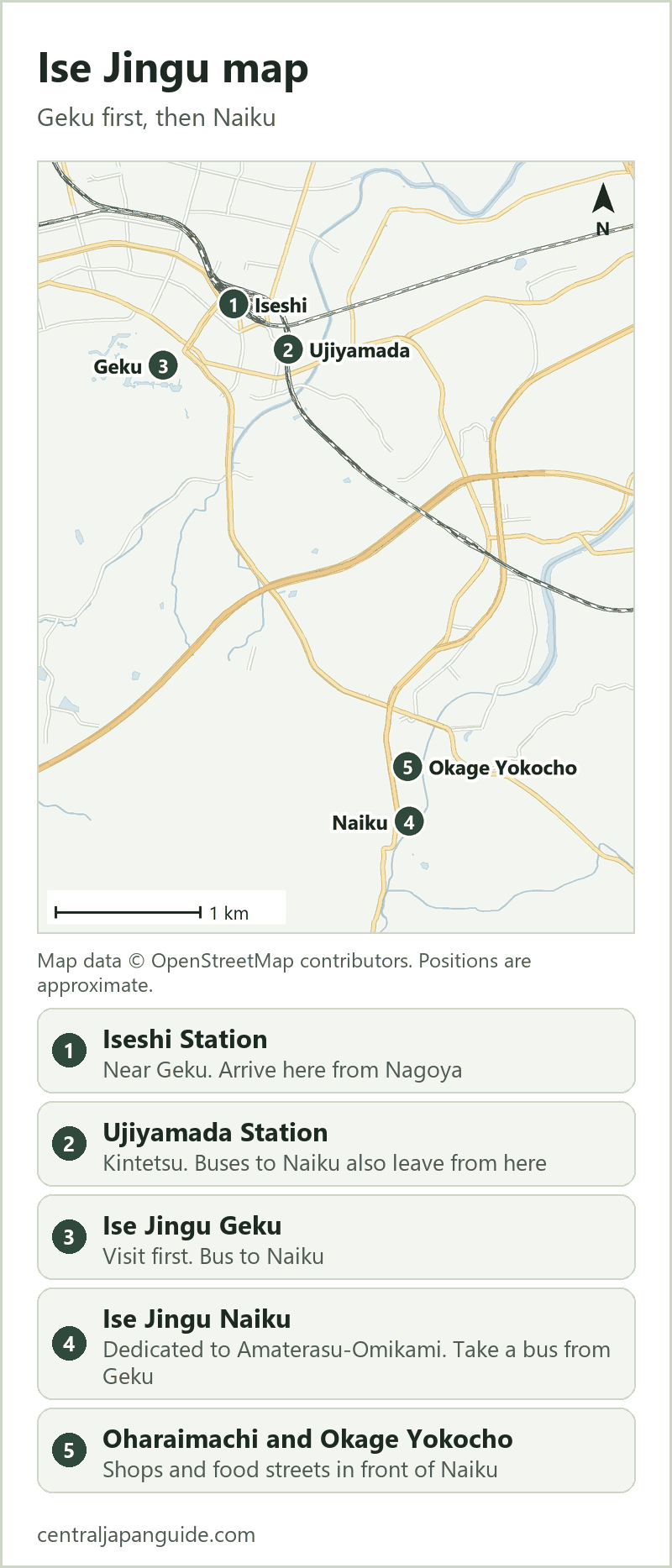
The Ise Jingu official access page says Geku comes first. The Shinto Liner bus stops in front of Geku right after Iseshi Station, so Geku is the natural first stop, and you then take a bus to Naiku.
Getting from Geku to Naiku
The official Ise Jingu site lists the Geku-Naiku Loop Line (route 51 or 55) and the Ise-Futami-Toba circular “CAN Bus”. The Ise City Tourism Association gives these details:
- Shinto Liner. A limited-stop bus. From the station it stops at Iseshi Station, the area in front of Geku (Sotomiya-mae), Isuzugawa Station and the area in front of Naiku (Naiku-mae).
- CAN Bus. A bus that runs around the sights from Ise to Toba, once an hour from Isuzugawa and from Toba. It stops in front of Isuzugawa Station and in front of Naiku (Naiku-mae), which is right in front of the Uji Bridge.
- Railway. The nearest railway station to Naiku is Kintetsu Isuzugawa Station, but the tourism association says it is about 2.3 kilometers from Naiku-mae, so take a bus from Iseshi or Ujiyamada Station.
The official pages do not give the bus fares or the timetable in text, so please check the Mie Kotsu timetable on the day.
Renting a bicycle
The Ise City Tourism Association rents bicycles at the Iseshi Station luggage storage (JR side, on the left as you exit) and at the Geku-mae tourist service center, among other places.
- Prices. A city bicycle is 800 yen for up to 4 hours and 1,000 yen for a day. An electric-assist bicycle is 1,500 yen for up to 4 hours and 2,000 yen for a day.
- Who can rent. Junior high school age and above, and at least 145 cm tall. There are no child-seat bicycles.
- Return. One-way drop-off is not possible. You must return the bicycle to the place where you borrowed it.
- Booking. The Iseshi Station and Geku-mae offices accept online reservations up to 4 days before.
- Helmets are lent free of charge.
- ID. You must show an ID such as a driver’s license or an insurance card.
Opening hours and manners
The official Ise Jingu “Pray” page lists the opening hours by month: from 5:00 to 17:00 in October, November and December, from 5:00 to 18:00 in January, February, March, April and September, and from 5:00 to 19:00 in May, June, July and August.
The same page explains the manners:
- Temizu. Wash your hands and rinse your mouth with the water before you pray. The official page describes the steps with the dipper, and asks you not to touch the dipper directly to your mouth.
- How to pray. Bow twice deeply, clap your hands twice, and bow once more deeply.
- Photos. Please do not take a picture at the place where you pray.
- Food and smoking. Eating, drinking and smoking are not allowed within the precinct except in designated areas.
Oharaimachi and Okage Yokocho
According to the Ise City Tourism Association, Oharaimachi is a cobblestone street of about 800 meters, running from the Uji Bridge in front of Naiku, lined with souvenir shops, restaurants and merchant houses. Okage Yokocho is in the middle of it, in front of the Akafuku main store. Buildings from the Edo to Meiji periods have been relocated and recreated there, and entry is free.
- Hours. Shops set their own hours, and the tourism association does not give a single time. Check the shop you want to visit before you go.
- Toilets. The official map lists toilets near the entrance of Oharaimachi at the Uji Bridge, near the Ujiurata parking lot, and in Okage Yokocho.
- Cars. On weekends and holidays, vehicles are not allowed on Naiku and Oharaimachi streets during set hours, with exceptions. See the Ise tourism site if you drive.
A simple day plan
1. Train to Iseshi Station from Nagoya, about 1 hour 20 minutes. 2. Geku first, as the official site asks. 3. Bus to Naiku, or by bicycle if you have booked one. 4. Naiku and the Uji Bridge, then Oharaimachi and Okage Yokocho for lunch and souvenirs. 5. Return to Nagoya by train. Check the last train before you go.
Tours from Nagoya
If you prefer not to plan the trains, Klook lists day tours from Nagoya. Both also stop at Meoto Iwa, the Wedded Rocks in Futami, which this guide does not cover.
For more of Nagoya, see our Nagoya Castle guide and our 3-day Nagoya itinerary. For tickets in the city, see our guide to getting around Nagoya.
Map
Open these places in Google Maps:
Frequently asked questions
How long does it take to go from Nagoya to Ise Jingu? About 1 hour 20 minutes from Nagoya Station to Iseshi Station by Kintetsu limited express, according to the Ise City Tourism Association. The JR Rapid Mie takes a little longer.
Should I go to Geku or Naiku first? Geku first, then Naiku, as the official Ise Jingu site asks.
What time does Ise Jingu close? It opens at 5:00. It closes at 17:00 in October, November and December, at 18:00 in January to April and September, and at 19:00 from May to August.
Can I take photos? Please do not take pictures at the place where you pray. Check the signs for other areas.
Is Okage Yokocho free? Yes. Entry is free, and the shops set their own hours.